|
Getting your Trinity Audio player ready...
|
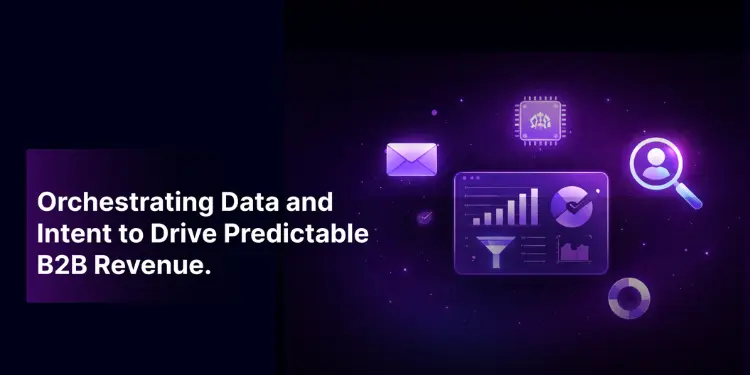
Predictable revenue has always been a major challenge for B2B companies. Marketing teams generate leads, sales teams follow up with prospects, and campaigns run across multiple platforms. Yet, despite these efforts, many organizations still struggle to convert marketing activity into consistent revenue.
One of the main reasons for this challenge is scattered or fragmented marketing execution. Businesses often run email campaigns, social media promotions, CRM outreach, and paid advertising independently.
While each channel may perform well individually, the lack of coordination between them prevents companies from fully understanding and influencing the buyer journey. This is where B2B multi-channel marketing becomes critical.
Multi-channel orchestration connects marketing channels, customer data, and automation systems into a unified framework. When combined with intent-based lead scoring and automation tools, this approach helps businesses identify high-value prospects and engage them at the right time.
In this article, we will explore how integrating marketing channels, using intent signals, and implementing automation strategies can help organizations achieve predictable revenue B2B growth.
Before exploring the benefits of multi-channel orchestration, it is important to understand why many B2B marketing strategies fail to deliver predictable results.
Most organizations operate with disconnected marketing systems. Data from email campaigns, advertising platforms, social media interactions, and CRM systems often remain isolated. This lack of integration makes it difficult to build a complete picture of the buyer journey.
As a result, companies face several challenges:
Customer interactions across different platforms often remain stored in separate tools. Marketing automation platforms, CRM systems, and advertising dashboards collect valuable information, but without integration, this data cannot be fully utilized.
This fragmented data environment prevents businesses from understanding how prospects move through the funnel.
Without behavioral insights, sales teams often treat all leads the same. This leads to wasted effort chasing prospects who are not ready to buy.
When marketing channels operate independently, prospects receive messages that may not align with their current stage in the buying process.
These challenges highlight why companies must shift toward coordinated B2B multi-channel marketing strategies that connect data, intent signals, and engagement channels.
ALSO READ – Revolutionizing B2B Marketing: LakeB2B’s Data Reseller Program
To overcome improper, scattered, and random campaigns, businesses must move beyond isolated marketing activities and adopt a coordinated engagement strategy.
B2B multi-channel marketing orchestration refers to the process of aligning multiple marketing and sales channels so that they work together as a unified system.
Instead of running independent campaigns, organizations synchronize their marketing activities across channels such as email, social media, paid advertising, and sales outreach.
This approach ensures that every customer interaction contributes to a consistent and personalized buyer experience. A well-orchestrated strategy typically includes several core components:
The CRM acts as the central hub for customer data, tracking interactions across marketing and sales channels.
Marketing teams align messaging across email, social media, and advertising platforms to maintain consistent communication.
Automation systems trigger engagement actions based on customer behavior and intent signals.
Together, these components create a unified marketing ecosystem capable of generating consistent pipeline growth.
Once organizations understand the concept of orchestration, the next step is integrating the major marketing channels that influence the buyer journey.
Successful orchestration begins with connecting the systems that manage customer interactions. This integration ensures that engagement data flows across platforms and supports coordinated outreach.
The CRM platform serves as the backbone of modern B2B marketing operations. It stores critical information about prospects, including company details, engagement history, and sales interactions. When CRM data integrates with marketing tools, organizations gain visibility into the full customer journey.
This insight allows teams to deliver more relevant communication at each stage of the funnel.
Email remains one of the most powerful channels in B2B multi-channel marketing strategies.
When integrated with CRM and automation platforms, email campaigns can respond dynamically to customer behavior.
Social media platforms play an important role in maintaining ongoing engagement with prospects. LinkedIn, in particular, allows B2B marketers to share thought leadership content, interact with industry professionals, and build trust with potential buyers.
When social engagement aligns with email campaigns and advertising efforts, prospects experience consistent brand messaging.
Paid advertising ensures that companies remain visible throughout the buyer research process.
Advertising platforms can retarget prospects who previously interacted with marketing content, reinforcing messaging and encouraging further engagement. Together, these channels create a coordinated marketing ecosystem.
While multi-channel integration improves visibility, identifying the right prospects remains equally important. This is where intent-based lead scoring becomes a powerful tool.
Intent data analyzes online behavior to identify signals that indicate a company may be researching solutions related to your offering.
Examples of intent signals include:
By analyzing these signals, marketing teams can identify accounts that are actively evaluating solutions.
Intent-based lead scoring assigns numerical values to prospect actions.
For example:
These scores help marketing and sales teams prioritize engagement.
When a prospect reaches a specific score threshold, automation systems can trigger follow-up actions such as email campaigns, sales notifications, or targeted advertising. This ensures timely engagement with high-intent prospects.
Modern buyers expect personalized communication. However, delivering individualized engagement across hundreds or thousands of prospects can be difficult without automation. This challenge is solved by combining ABM and automation.
Account-based marketing focuses on targeting specific high-value accounts with tailored messaging. Automation platforms make it possible to scale this approach across multiple industries and segments.
Different industries have unique challenges and priorities.
Automation systems allow marketers to segment audiences and deliver industry-specific messaging that addresses these unique needs.
ABM strategies enable companies to create personalized campaigns for priority accounts.
These campaigns may include targeted email sequences, customized landing pages, and industry-specific content.
By combining automation with personalization, companies can engage prospects more effectively.
When marketing channels, intent insights, and automation platforms work together, businesses gain a powerful advantage.
Instead of reacting to leads after they appear, companies proactively engage prospects throughout the buyer journey. This integrated approach produces several measurable benefits.
These benefits ultimately lead to predictable revenue B2B growth, which is the ultimate goal of modern marketing strategies.
Organizations that want to implement successful B2B multi-channel marketing strategies should follow several best practices.
First, integrate all marketing and sales systems so that customer data flows across platforms.
Second, adopt intent-based lead scoring to prioritize high-value prospects.
Third, use ABM and automation tools to personalize engagement across industries.
Finally, continuously monitor campaign performance and adjust strategies based on real data insights.
These practices help organizations build a scalable and predictable marketing engine.
Modern B2B marketing requires more than isolated campaigns. To achieve consistent growth, businesses must coordinate their marketing channels and use behavioral insights.
By integrating CRM systems, email campaigns, social media engagement, and paid advertising into a unified strategy, companies can build powerful B2B multi-channel marketing ecosystems.
When these systems are enhanced with intent-based lead scoring and ABM and automation, organizations gain the ability to prioritize high-value prospects and deliver personalized engagement.
The result is a marketing framework capable of generating consistent pipeline growth and achieving predictable B2B revenue outcomes.
LakeB2B helps you find, enrich, and connect with verified B2B contacts using accurate data, intent signals, and audience intelligence so your sales and marketing teams can reach the right decision-makers with confidence.
Achieve Greater Transparency and Enhanced Visibility in Reaching and Engaging with Ideal Customers
Submit the form below and our team will contact you.
 September 02, 2026 / 16 min read
By: Bryan Scott
 August 17, 2026 / 22 min read
By: Bryan Scott
 July 15, 2026 / 13 min read
By: William Shepherd