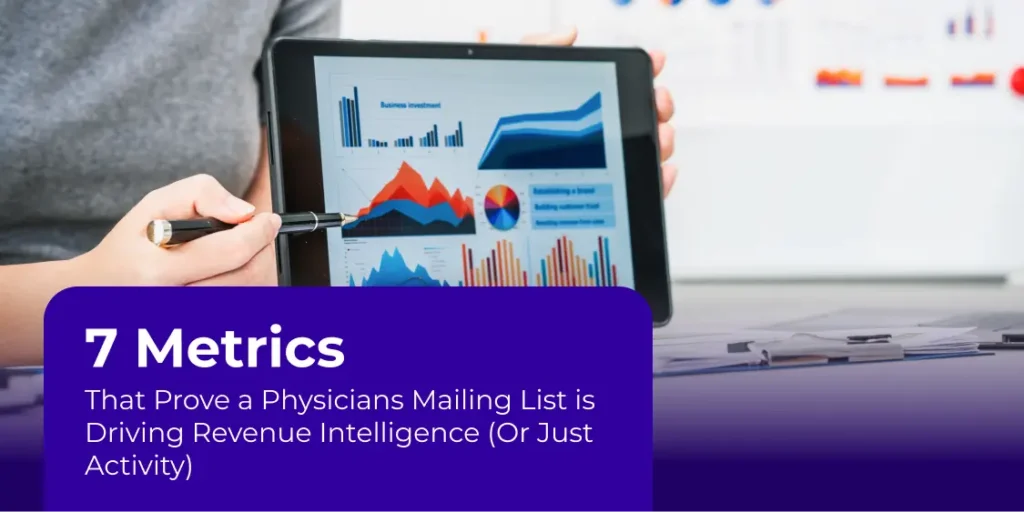
7 Metrics That Prove a Physicians Mailing List is Driving Revenue Intelligence (Or Just Activity)
Summarize with AI
|
Getting your Trinity Audio player ready...
|
Most teams evaluate a physicians mailing list using email performance metrics. That’s a convenient shortcut, but it misses the real point.
Open rates and clicks only confirm that your message was delivered and noticed. They don’t tell you whether you’re reaching physicians who are actually moving toward a decision.
A physicians mailing list only becomes valuable when it behaves like an intelligence layer. It should help you understand who is active, who is relevant right now, and who has real conversion potential.
Below are seven metrics that separate static contact databases from true revenue intelligence systems. These indicators show whether your physicians mailing list is contributing meaningful insight or just generating surface-level engagement.
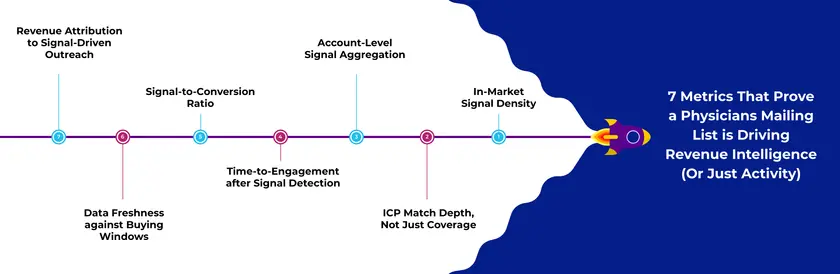
1. In-Market Signal Density
The real question is not how many physician emails you have. It is how many of those contacts are showing active buying signals.
This includes recent engagement with healthcare solutions, content consumption patterns, and technology adoption indicators.
If your physicians email database is not enriched with intent signals, you are operating blind.
A high-performing dataset should consistently surface a measurable percentage of physicians who are already in research or evaluation mode.
2. ICP Match Depth, Not Just Coverage
Many providers focus on scale. Millions of physician contacts across geographies and specialties. That is volume, not intelligence.
What matters more is how precisely your list aligns with your ideal customer profile across multiple layers, not just basic identifiers.
A high-quality doctors mailing list should allow segmentation such as:
- Practice size and structure
- Decision-making authority
- Technology stack or environment
- Institutional or network affiliations
Without this depth, prioritization becomes guesswork, and high-value opportunities get lost in broad targeting.
3. Account-Level Signal Aggregation
B2B healthcare decisions are rarely individual. They happen across teams, departments, and institutions.
If your physicians email database is treated as isolated contacts, you lose the bigger picture.
A stronger approach is to track how many contacts within the same hospital, clinic, or healthcare group are showing activity at the same time.
When engagement clusters at the account level, it often reflects coordinated evaluation. That is far more meaningful than standalone clicks or opens. Your list should make these clusters visible, not hidden.
4. Time-to-Engagement after Signal Detection
“Speed matters once intent is identified.” Track how quickly your team reaches out after a physician shows a signal. Then measure how quickly that interaction converts into meaningful engagement.
If your system detects interest but your outreach lags, the value of your physicians email lists drops sharply.
Data intelligence is not just about identifying signals. It is about acting on them before competitors do.
5. Signal-to-Conversion Ratio
Not every intent signal will convert, but there should be a clear relationship between signals and outcomes.
Track how many signal-qualified physicians from your doctors email database progress into:
- Sales conversations
- Product evaluations
- Active pipeline opportunities
If signals do not consistently map to conversions, the intent layer is either too noisy or not properly calibrated.
This is where many datasets fail. They generate activity, but not direction.
6. Data Freshness against Buying Windows
Healthcare buying cycles are not static. A physician who showed interest three months ago may no longer be relevant today. Your physicians email database must be evaluated on how frequently it refreshes:
- Contact accuracy
- Role changes
- New intent signals
This is especially critical for region-specific datasets like a UK physicians email list, where compliance and data accuracy expectations are stricter.
If your data does not reflect current reality, your outreach will always lag behind the market.
7. Revenue Attribution to Signal-Driven Outreach
This is the final and most important metric.
You should be able to trace revenue back to specific signals and the contacts associated with them.
That includes identifying which physician emails were flagged through intent, how they were prioritized, and which opportunities were influenced by that targeting.
When properly integrated, a physicians mailing list should contribute directly to pipeline creation and deal progression.
If revenue cannot be linked back to data-driven targeting, then the system is not delivering intelligence. It is only supporting campaign execution.
Where LakeB2B Fits Into This
Most B2B data providers focus on access to contact records resulting in large databases with little context. LakeB2B takes a fundamentally different approach.
📊 Intent-Driven Targeting
Identify in-market physicians using real-time intent signals instead of guesswork.
🏥 Account-Level Mapping
Understand relationships across hospitals and healthcare networks for better targeting.
🎯 Deep Segmentation
Go beyond surface filters with ICP-based segmentation tailored to your ideal buyers.
🔄 Continuous Data Validation
Maintain high accuracy through ongoing verification and refresh cycles.
🚀 From Database to Decision Engine
This transforms a physicians mailing list from a static contact repository into a prioritization system guiding teams toward the right prospects based on real buying behavior.
The result? Better conversations, sharper pipeline visibility, and faster deal progression.
To Conclude
A physicians mailing list is not judged by its size. It is proven by what it drives.
The 7 metrics in this framework separate revenue intelligence from simple activity. They show whether your data is actually influencing decisions or just supporting outreach volume.
When in-market signals, ICP fit, account clustering, speed of engagement, conversion alignment, data freshness, and revenue attribution are strong, your database becomes a decision-making system, not just a contact list.
When they are weak, it stays limited to surface-level activity with no real direction.
In B2B healthcare, the difference between activity and intelligence is measurable. These metrics are how you see it clearly.
Table of Contents
Enjoying this article?
Ready to turn insights into pipeline?
LakeB2B helps you find, enrich, and connect with verified B2B contacts using accurate data, intent signals, and audience intelligence so your sales and marketing teams can reach the right decision-makers with confidence.