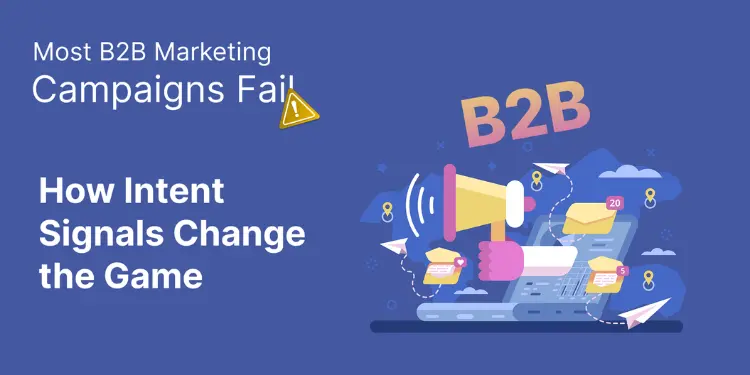
Why Most B2B Marketing Campaigns Fail: How Intent Signals Change the Game
Summarize with AI
|
Getting your Trinity Audio player ready...
|
B2B marketing has never had more tools, more data, or larger budgets. Yet many campaigns still fail to generate a qualified lead pipeline.
Web traffic increases. Webinar registrations grow. Content downloads look impressive. But revenue remains inconsistent. The real problem is not effort; it is direction.
Most B2B SaaS and tech campaigns rely on assumptions instead of behavioral evidence. They target broad audiences and hope the right buyers respond.
In 2026, guessing no longer works. Intent signals are transforming B2B marketing insights into actionable strategies that prioritize the right accounts at the right time.
This article explores why traditional campaigns fail, how SaaS intent data changes targeting precision, and how early engagement powered by behavioral insights creates measurable impact.
Why Most B2B Marketing Campaigns Fail
Understanding failure is the first step toward improvement.
1. Targeting Too Broad an Audience
Many tech demand generation strategies aim for scale. They cast a wide net through paid ads, content marketing, and email campaigns.
While this approach generates visibility, it often lacks relevance. Not every visitor is actively looking for a solution. Without filtering for buying intent, campaigns attract researchers, students, competitors, and low-priority prospects. This dilutes the qualified lead pipeline.
2. Relying on Static Buyer Personas
Buyer personas are useful, but they are static representations of dynamic markets. A persona tells you who might buy. It does not tell you when they are ready to buy. Campaigns based only on firmographics and job titles miss real-time behavioral shifts.
3. Ignoring Buying Signals
Prospects leave digital footprints through actions like searching for solution comparisons, reading competitor reviews, downloading pricing guides, and engaging with industry-specific content.
When campaigns overlook these signals, outreach becomes mistimed, causing sales teams to contact accounts either too early or too late, missing the window of opportunity for a more effective engagement.
4. Measuring Vanity Metrics
High impressions and form fills look impressive in reports. However, they do not guarantee revenue. Without aligning marketing metrics to pipeline contribution, teams lose focus on what truly matters.
These pitfalls are common across B2B SaaS and tech marketing strategies. The solution lies in intent-driven precision.
The Power of Behavioral Insights and Real-Time Signals
Intent signals provide visibility into what prospects are actively researching. Unlike demographic data, behavioral insights reveal urgency.
SaaS intent data tracks engagement patterns across digital channels. It identifies accounts consuming content related to specific technologies, problems, or competitors.
This shifts the strategy from reactive to proactive, moving from assumption to evidence
Instead of asking, “Who fits our target profile?” marketers can ask, “Who is actively looking for solutions like ours right now?”
That shift changes the campaign approach entirely. Accounts showing high-intent behavior can be prioritized for outreach, served personalized ads, added to tailored email sequences, or flagged for immediate sales follow-up. This ensures marketing efforts are focused on accounts with a higher likelihood of conversion.
How Intent Signals Improve Tech Demand Generation
Intent-driven campaigns transform every stage of the funnel.
1. Smarter Audience Segmentation
With SaaS intent data, companies can categorize accounts into high, moderate, or low intent. High-intent accounts get decision-stage content, moderate-intent accounts receive educational resources, and low-intent accounts stay in awareness campaigns. This segmentation makes outreach more relevant.
2. Better Timing
Timing is key in B2B sales. Engaging a prospect during their research phase boosts engagement, while waiting until they contact competitors lowers the chances of winning. Real-time signals help sales teams reach out early, at the right moment.
3. Higher Conversion Rates
When outreach aligns with buyer interest, response rates increase. Messages referencing the exact problem an account is researching feel helpful rather than intrusive. This improves the quality of conversations and accelerates deal progression.
Case Studies that Prove Early Engagement & Lead Prioritization in SaaS/Tech
Case Study 1:
A mid-sized SaaS cybersecurity provider struggled with low demo booking rates despite strong website traffic.
After integrating SaaS intent data, the company identified accounts repeatedly searching for endpoint security comparisons and reading threat mitigation content.
Instead of broad retargeting, the marketing team launched targeted campaigns focused only on those high-intent accounts. Sales representatives received alerts when intent activity spiked.
Within three months:
- Demo booking rates increased
- Sales cycle length decreased
- Win rates improved
The shift from volume-based targeting to intent-based prioritization strengthened their qualified lead pipeline.
Case Study 2:
A B2B cloud infrastructure company faced long sales cycles and inconsistent pipeline growth.
Their marketing team generated large volumes of leads, but sales struggled to identify which accounts deserved immediate attention.
By applying behavioral insights, they ranked leads based on intent intensity. High-scoring accounts were assigned to senior sales representatives. Lower-scoring accounts entered nurturing workflows.
The result was a measurable improvement in pipeline velocity. The company reduced wasted outreach and improved revenue predictability.
These case studies highlight a simple truth: precision outperforms scale.
Building an Intent-Driven Qualified Lead Pipeline
There are 4 steps to transforming your lead generation into a high-impact, intent-driven pipeline that delivers measurable ROI.
Step 1: Integrate Intent Data Sources
Combine first-party data, such as website behavior, with third-party SaaS intent data to create a comprehensive view of account activity.
Step 2: Align Marketing and Sales
Intent signals should be shared across teams, marketing identifies in-market accounts, while sales takes timely action. Shared dashboards keep everyone aligned and ensure transparency.
Step 3: Personalize Messaging
Intent insights reveal the topics prospects care about. This information can be used to craft email content, ad messaging, webinar invitations, and case study recommendations. The result? Increased relevance and stronger trust.
Step 4: Measure Pipeline Impact
Track metrics such as:
- Conversion rate by intent level
- Sales cycle duration
- Revenue influenced by intent-driven campaigns
- Cost per opportunity
Why Intent Signals Change the Game
Traditional B2B marketing depends on broad outreach and delayed responses, while intent-driven strategies focus on precision and proactive engagement.
By leveraging real-time behavioral insights, companies can direct resources to high-value accounts, boost campaign ROI, speed up deal velocity, and strengthen their qualified lead pipeline. In competitive SaaS and tech markets, even small timing advantages can lead to a big revenue impact, and intent signals provide that edge.
Conclusion
Most B2B marketing campaigns fail not because of poor creativity or limited budgets, but because they lack behavioral intelligence. Broad targeting, static personas, and vanity metrics dilute effectiveness.
Intent-driven strategies change this model. By leveraging SaaS intent data and real-time behavioral insights, companies gain deeper B2B marketing insights that improve tech demand generation performance.
Instead of guessing who is ready to buy, marketers can act on evidence. This precision creates stronger engagement, faster pipeline movement, and measurable ROI.
In 2026 and beyond, the companies that win will not be the ones who market the loudest. They will be the ones who listen to buyer intent and respond at the right moment.
Table of Contents
Ready to turn insights into pipeline?
LakeB2B helps you find, enrich, and connect with verified B2B contacts using accurate data, intent signals, and audience intelligence so your sales and marketing teams can reach the right decision-makers with confidence.