Think back to when Uber launched in 2009. It did not just introduce a new app; it changed how people thought about transportation.
Now imagine launching the same idea today. Well, it would barely stand out, right? That is how fast technology moves.
What feels disruptive today becomes standard tomorrow. The global tech industry reflects that pace. As of 2026, the tech industry is valued at over $5 trillion, with constant expansion driven by AI, cloud computing, and digital infrastructure.
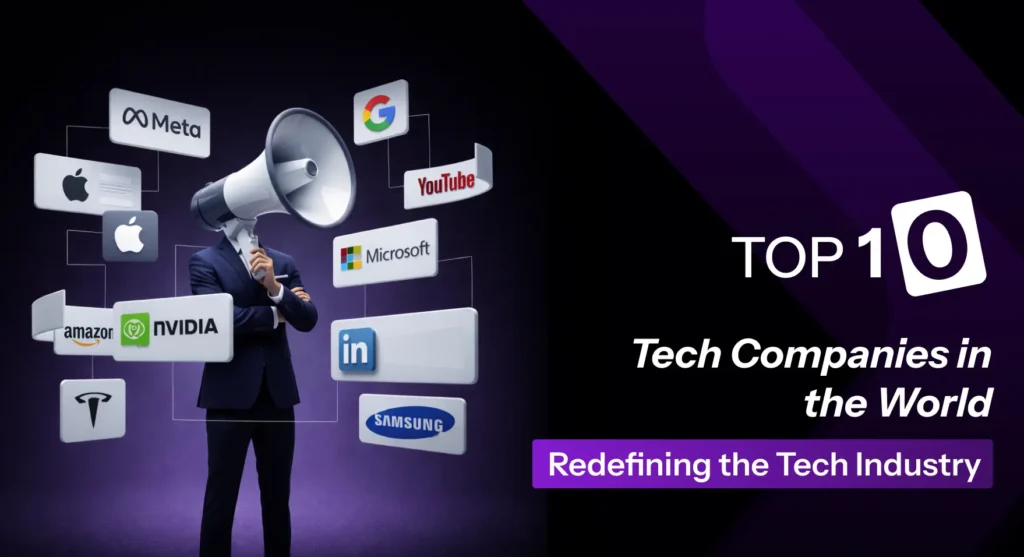
Thousands of companies operate in this space. But only a few consistently shape how industries evolve. This list focuses on the top 10 tech companies that are not just growing but actively redefining how technology is built, used, and scaled.
Let’s get started!
Microsoft has quietly positioned itself at the center of modern technology. Its strength today is not just software but ecosystem control. Azure powers enterprise infrastructure, Microsoft 365 runs daily business operations, and its AI integrations through Copilot are changing how people work.
With deep investments in AI and enterprise platforms, Microsoft is shaping both productivity and infrastructure at scale.
Amazon continues to operate at a scale few companies can match, with annual revenue surpassing $550 billion across multiple business segments. While its e-commerce platform remains a global benchmark for digital retail, its influence extends far beyond online shopping.
Amazon Web Services (AWS) generates over $90 billion annually and serves as the backbone for countless startups, enterprises, and government systems, offering computing power, storage, and advanced AI capabilities. Alongside this, Amazon has built one of the most sophisticated logistics networks in the world, powered by automation, robotics, and predictive analytics to optimize delivery speed and efficiency.
Its growing investments in AI, from recommendation engines to supply chain intelligence, further strengthen its operational edge. By combining commerce, cloud infrastructure, and intelligent logistics into a single ecosystem, Amazon continues to define what large-scale digital operations look like by quietly setting the pace while everyone else tries to keep up.
NVIDIA has become one of the most important companies in the world because of AI. Its GPUs power machine learning models, data centers, and generative AI systems. Most modern AI applications rely on NVIDIA hardware in some form.
As demand for AI infrastructure grows, NVIDIA is no longer just a chip company. Modern business analysts consider NVIDIA to be the backbone of the AI economy.
Alphabet Inc. continues to shape how information is discovered, processed, and used at scale. While its search engine remains a primary entry point to the internet, its influence now stretches far deeper into enterprise and developer ecosystems.
Platforms like Google Cloud support data storage, analytics, and infrastructure needs for businesses across industries, while their advancements in AI models and machine learning frameworks are driving automation, personalization, and decision-making capabilities.
From advertising to enterprise SaaS, Google’s ability to connect data, intent, and intelligence keeps it central to how modern digital systems are built and optimized.
Apple Inc. continues to stand out through its tightly controlled ecosystem, where hardware, software, and services are designed to work as a unified experience. Devices like the iPhone, Mac, and wearables such as the Apple Watch are flawlessly connected through their operating systems and services like iCloud and the App Store.
This level of integration allows Apple to maintain consistent performance, security, and user experience across devices. Beyond products, its growing focus on services, privacy positioning, and custom silicon development strengthens long-term ecosystem control, making it less dependent on external technologies and more resilient in a competitive market.
SpaceX has changed the economics of space. By developing reusable rockets, it reduced launch costs and made space access more practical. It also operates Starlink, providing satellite internet across regions where connectivity is limited.
SpaceX is not experimenting. It is executing at scale in an industry that traditionally moved slowly.
Tesla did not invent electric vehicles; it made the entire concept relevant and easy for the population. The company played a major role in pushing EV adoption into the mainstream. Today, Tesla remains one of the most valuable automotive companies, with global EV demand continuing to rise.
But Tesla’s influence goes beyond vehicles. Its ecosystem includes energy storage, solar technology, and AI-driven driving systems. It operates like a technology company that happens to build cars.
Meta is focused on the future of digital interaction. Its social platforms dominate global communication, but its long-term investments are in AI and virtual environments.
From AI-driven content systems to VR hardware, Meta is experimenting with how people will interact digitally in the next decade.
Adobe generates over $19 billion in annual revenue, driven by its Creative Cloud and Experience Cloud platforms. The company operates at the intersection of content creation, document workflows, and customer experience. Its core products, such as Adobe Photoshop, Adobe Acrobat, and the broader Adobe Experience Cloud, are deeply embedded in how businesses design, manage, and deliver digital assets.
What strengthens Adobe’s position is how it connects creativity with data. Content created through its tools can be directly tied to customer journeys, campaign performance, and personalization strategies. This allows businesses not just to produce content but to understand how it performs and where it drives engagement.
OpenAI has introduced a new paradigm in how software is utilized. Its generative AI models are now embedded across industries, supporting everything from content creation to software development.
Its tools are used by over 1 million businesses globally, with billions of queries processed daily across enterprise and consumer applications.
OpenAI’s impact lies in redefining how individuals and organizations interact with technology at scale.
These companies operate in different areas, but they follow similar patterns:
Identifying companies like these is useful. But for most businesses, the real challenge is not awareness. It is access.
Reaching the right decision-makers inside these organizations requires more than a basic contact list. This is where LakeB2B becomes relevant.
LakeB2B provides technology-driven B2B data that helps businesses identify companies based on:
Rather than reaching out to all tech companies, businesses can focus on those using specific platforms or tools and on the teams that manage AI, cloud, or infrastructure. They can also target the right decision-makers in IT, operations, or procurement.
This approach makes outreach more precise, helping teams connect with the people who are most likely to respond and take action. All that’s needed for this is a 100% verified email list from LakeB2B.
Updated and well-segmented data makes a measurable difference, especially when roles, tools, and team structures keep changing. It helps businesses stay aligned with current realities instead of relying on outdated assumptions, because guessing the right contact is expensive, and silence is even more so.
Technology does not just move fast; it compounds. What seems advanced today becomes the standard tomorrow. The companies on this top 10 list of tech organizations stand out because they continue to evolve rather than rely on past successes.
Some are creating entirely new industries, while others are reshaping existing ones. In both cases, their impact comes from constantly looking forward and adjusting to new opportunities.
The common thread is simple. They do not stop adapting. This ongoing commitment to change is what keeps them ahead of the competition.
Achieve Greater Transparency and Enhanced Visibility in Reaching and Engaging with Ideal Customers
Submit the form below and our team will contact you.
 April 08, 2026 / 8 min read
By: Ajith D
 January 08, 2026 / 5 min read
By: John Williams
 January 06, 2026 / 11 min read
By: Bryan Scott