Attorney Email List: How to Choose One and Turn It into Revenue Pipeline
Summarize with AI
If you are evaluating an attorney email list, the choice matters more than the spend. Most teams buy a list, blast a campaign, and wonder why nothing converts. The offer is usually fine. The data underneath it is not. A poor list sinks even a strong offer, and any automation you point at it just scales the mistakes.
Attorneys are not a monolith. A solo immigration practitioner has nothing in common with an M&A partner at a 500-person firm except a law degree. Treat them the same, and both tune out. This guide covers what a buyer needs: how to segment the list, how to use it, how to vet the provider, what compliance requires, and how to test before you scale.
Segment your attorney email list before anything else
Match the message to the contact, not the inbox count. The filters that drive reply rates:
- Practice area: personal injury, corporate, immigration, criminal defense, employment, IP, tax, real estate, bankruptcy. A family law attorney cares about intake volume; an IP litigator cares about case management complexity.
- Firm size: solos decide in an afternoon; Am Law firms run procurement, security reviews, and multi-year budgets.
- Geography: California adds CCPA context, which becomes a direct hook if you sell compliance tools.
Well-segmented outreach tends to reach 6 to 9 percent reply rates, against the 3 to 4 percent typical of generic sends. Raw list size is not the metric. The number of precise filters is.
7 ways to turn an attorney email list into pipeline
- Cold email sequences built on practice-specific pain. Five to eight short touches over 20 to 30 days, one problem each, social proof by email four.
- Account-based marketing for 50 to 100 high-value firms filtered by revenue, headcount, geography, and practice area, with partners and decision-makers mapped per account.
- CLE webinar invitations to a target practice area: invite 7 to 10 days out, remind two days before, follow up within 48 hours.
- Content syndication that builds authority first, sending practice-area benchmark reports before any pitch.
- Re-engagement of attorneys who opened but went cold, using a new angle rather than a louder repeat.
- Cross-sell and upsell inside firms you already serve by filtering on firm name and excluding current users.
- Referral and partnership plays with legal tech vendors, bar associations, recruiters, and malpractice insurers who serve the same base.
Attorney email list compliance: CAN-SPAM and CCPA
- CAN-SPAM applies to B2B cold email, and buying a list does not transfer responsibility to the vendor. Use accurate headers and subject lines, a valid postal address, and a working opt-out, and honor unsubscribes within ten business days.
- CCPA applies to California residents, and “business contact” status does not remove the obligation. Confirm the vendor’s data-processing disclosures, suppression process, and consent documentation before you buy.
Test the list before you scale
Run a controlled pilot of 200 to 500 contacts, hold the message and CTA constant, and warm the domain first. Watch four signals:
- Bounce rate: keep under 2 percent. Above 3 percent on a “verified” list means it was not recently validated. Pause.
- Open rate: 30 to 32 percent is the legal services average; 40 percent is an ambitious benchmark for sharp segmentation.
- Reply rate: 3 to 4 percent to start, 6 to 9 percent for strong quality.
- Inbox placement: verify addresses first with an email verification guide.
If the pilot clears the thresholds, scale in phases rather than sending the full list at once.
Where to source a verified attorney email list
The deciding question is whether a vendor hands you a static download or builds to your filters. Custom-built lists match your ICP directly instead of forcing weeks of cleanup.
LakeB2B’s database of verified business profiles includes pre-segmented attorney records filterable by practice area, firm size, geography, and title. LakeB2B builds custom lists to your criteria, revalidates continuously, and covers the execution layer too: multichannel campaign management, sales development, and intent data. That moves you from a verified legal email database to a live pipeline campaign without stitching vendors together.
Bottom line
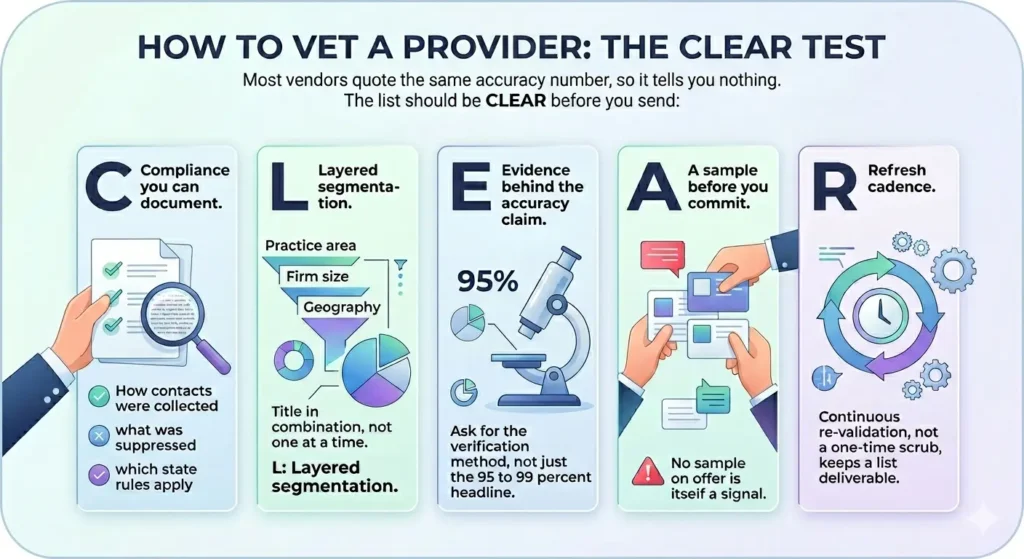
A raw attorney email list is a commodity. A verified, segmented, compliance-vetted one is a pipeline asset. Segment first, run every provider through the CLEAR test, pilot before you scale, and source a custom file matched to your ICP.
FAQs
- Are purchased attorney email lists legal? Yes, when you follow CAN-SPAM and, for California residents, CCPA. The responsibility sits with the sender, not the vendor.
- How much does an attorney email list cost? It varies with volume and segmentation. A custom verified list costs more per contact but usually delivers a far lower cost per reply.
- What is the best provider? The one that passes the CLEAR test and builds to your ICP rather than selling a one-time download.
Table of Contents
Ready to turn insights into pipeline?
LakeB2B helps you find, enrich, and connect with verified B2B contacts using accurate data, intent signals, and audience intelligence so your sales and marketing teams can reach the right decision-makers with confidence.