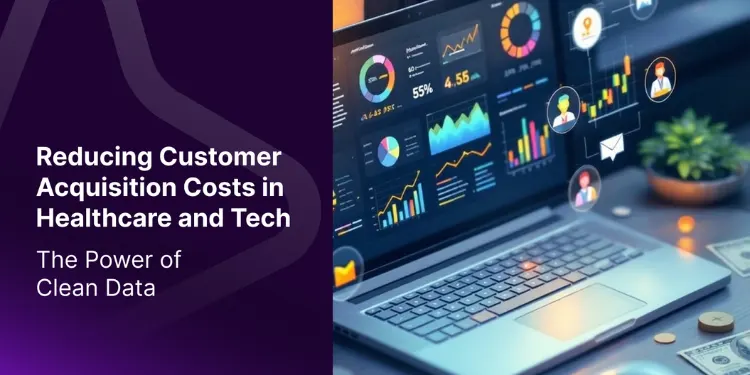
Reducing Customer Acquisition Costs in Healthcare and Tech: The Power of Clean Data
Summarize with AI
|
Getting your Trinity Audio player ready...
|
Customer acquisition costs are rising across sectors, especially in healthcare and technology. Today, paid ads are more expensive than ever, the competition is stronger, and the buyers have become extremely selective.
Instead of figuring out better ways to cut down costs, many companies continue to lose budget on a hidden problem: poor data quality.
Outdated contacts, incorrect email addresses, duplicate records, and incomplete company profiles silently increase acquisition costs. Marketing teams invest in campaigns that never reach the right decision-makers. Sales teams chase contacts who no longer work at the organization.
The rule is simple: if your database is inaccurate, every campaign becomes less effective.
This article explains how outdated data increases costs, how it affects email deliverability and engagement, and how clean, verified data can help reduce customer acquisition costs (CAC) with data-driven precision.
The True Cost of Outdated or Inaccurate Data

Data decays faster than most companies realize. In industries like healthcare and technology, job changes, promotions, mergers, and restructuring happen frequently.
When your healthcare marketing database or B2B tech contact lists are outdated, the consequences are significant.
1. Wasted Advertising Spend
If ads are targeted using inaccurate firmographic or contact data, impressions are served to the wrong audience.
For instance, messaging reaches junior staff instead of decision makers. Campaigns target companies that are no longer a fit. And budgets are allocated to inactive or dissolved businesses. Every such misdirected impression increases acquisition cost.
2. Sales Team Inefficiency
Sales representatives spend valuable time calling disconnected numbers, emailing invalid addresses, and following up with irrelevant prospects. All this reduces productivity and lowers morale.
3. Missed Revenue Opportunities
Inaccurate data not only increases cost but also reduces opportunity. When the right contacts are missing from your database, competitors gain an advantage. In healthcare and tech, where buying committees are complex, missing even one key stakeholder can delay or kill a deal. So, clean data is not just an operational need. It is a revenue driver.
How Poor Data Affects Email Deliverability

Email remains a primary channel for B2B outreach. However, poor data quality directly damages deliverability.
1. High Bounce Rates
Sending emails to invalid or outdated addresses increases bounce rates. Email service providers track this behavior.
When bounce rates rise, your brand reputation goes down the drain, future emails are redirected to spam, and campaign performance drops.
Even valid contacts may stop receiving your emails because your sender reputation is damaged.
2. Lower Engagement Metrics
If your database includes irrelevant contacts, open rates and click-through rates decrease. Low engagement signals to email providers that your content lacks relevance. Over time, inbox placement suffers.
For healthcare marketing database campaigns or tech B2B contact lists outreach, this can significantly reduce performance.
3. Risk of Blacklisting
Repeatedly sending to invalid or risky emails can lead to blacklisting. Recovering domain reputation takes time and additional resources, which increases CAC further.
Clean, verified leads for B2B campaigns help maintain strong deliverability and protect brand credibility.
How Outdated & Inaccurate Data Increases CAC
The overall customer acquisition cost for businesses would be for advertising spend, marketing technology tools, team salaries, campaign costs, and product discounts for closing deals.
So, when outreach fails due to inaccurate data, all these investments become inefficient. Data is the backbone of customer acquisition. Here is how poor data directly increases CAC:
- More emails are required to generate one meeting
- More calls required to reach an actual decision-maker
- Longer sales cycles due to miscommunication
- Higher paid ad frequency to compensate for low engagement
Instead of scaling efficiently, companies spend more to achieve the same results. Reducing CAC with data begins by improving database accuracy.
The ROI Boost from Clean and Verified Data
Clean data transforms marketing and sales performance.
1. Higher Deliverability and Engagement
Better customer engagement improves sender reputation, which further strengthens performance. With quality data, you get verified leads for B2B outreach, and with that, you enable a decrease in bounce rates and an increase in open rates and click-through rates.
2. More Accurate Targeting
Accurate firmographic and contact data ensures campaigns reach healthcare administrators, IT directors, CTOs, procurement heads, compliance managers, and more. With such precision targeting, you can improve message relevance and conversion rates.
3. Shorter Sales Cycles
When sales teams connect with the correct decision makers from the start, deals progress faster. Less time is wasted navigating organizational structures.
4. Improved Marketing ROI
When outreach reaches qualified prospects, fewer impressions are wasted, and cost per meeting decreases. This is a measurable improvement in return on investment.
Why Clean Data Matters Especially in Healthcare and Tech
Both industries face unique challenges.
Healthcare Sector
Healthcare organizations operate within strict regulatory frameworks. Decision-making often involves multiple stakeholders such as hospital administrators, compliance officers, and IT security teams.
If your healthcare marketing database lacks accurate contact information, your campaigns may miss critical influencers.
Additionally, trust is vital in healthcare marketing. Reaching the wrong individuals with irrelevant messaging can damage brand perception.
Technology Sector
In tech, rapid innovation means constant role changes and organizational restructuring.
Tech B2B contact lists become outdated quickly. New departments are created. Titles evolve. Companies pivot business models.
Without continuous data verification, outreach becomes misaligned with current needs. Clean data ensures your messaging aligns with the right people at the right time.
Best Practices for Maintaining Clean Data
Reducing CAC with data requires ongoing effort.
1. Regular Data Audits
2. Email Verification Tools
3. Real-Time Data Enrichment
4. CRM Hygiene
5. Invest in Verified Data Providers
Measuring the Impact of Clean Data on CAC
As data quality improves, CAC should decline while revenue efficiency increases. And to evaluate success, track these metrics:
- Bounce rate reduction
- Open rate improvement
- Meeting booking rate
- Cost per qualified lead
- Cost per opportunity
- Overall customer acquisition cost
Conclusion
Rising acquisition costs are a major concern for healthcare and technology companies. However, one of the most overlooked drivers of high CAC is poor data quality.
Outdated contacts damage email deliverability, reduce engagement, waste advertising spend, and slow down sales cycles.
By investing in clean healthcare marketing database systems and accurate tech B2B contact lists, companies can reach verified leads for B2B campaigns and significantly reduce CAC with data-driven precision.
Clean, verified data improves targeting, strengthens engagement, shortens sales cycles, and boosts overall ROI.
In competitive industries like healthcare and tech, data accuracy is not just an operational requirement. It is a competitive advantage that directly impacts revenue growth.
Table of Contents
Enjoying this article?
Ready to turn insights into pipeline?
LakeB2B helps you find, enrich, and connect with verified B2B contacts using accurate data, intent signals, and audience intelligence so your sales and marketing teams can reach the right decision-makers with confidence.