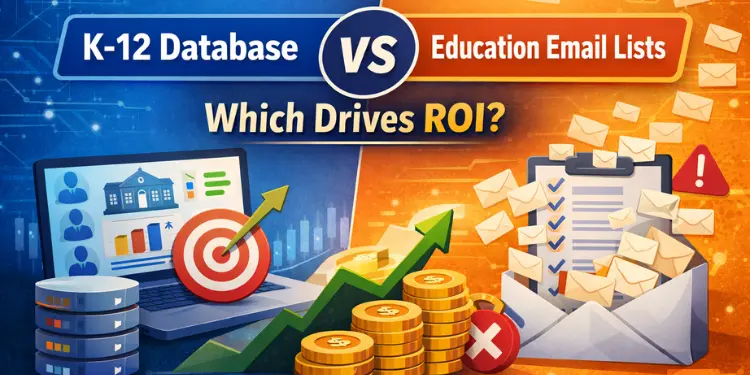
Reaching decision-makers in the education sector requires more than access to large volumes of contact data.
Many organizations rely on education email lists to run outreach campaigns targeting schools, districts, and educational institutions. At first glance, these lists appear sufficient. They offer thousands of contacts and promise a broad reach across the education industry. However, campaign results often tell a different story.
Low response rates, high bounce rates, and limited engagement are common outcomes. The issue is not the outreach strategy alone. It is the quality and structure of the data being used.
This is where the distinction between a K-12 database and a standard education email list becomes critical.
While both are used to target the same audience, they serve very different purposes. Understanding this difference is essential for improving campaign performance and ensuring that outreach efforts translate into measurable results.
This article illustrates the difference and explains why you need the best for your campaigns. Let’s get started!
Education email lists are typically collections of contact information associated with individuals working in the education sector.
These lists may include contact information of teachers, administrative staff, school-level contacts, and general institutional authorities.
In most cases, the data is compiled from multiple sources and aggregated into a single database. While this provides volume, it often lacks depth and context.
That is why any education mailing list gets commonly used for broad marketing campaigns, awareness initiatives, or general outreach across institutions. The bottom line is that the effectiveness of these lists depends heavily on how well the data is maintained and segmented.
A K-12 database goes beyond basic contact information. It is a structured database built specifically to support targeted outreach within schools and districts. Instead of focusing on volume, it emphasizes accuracy, segmentation, and relevance.
A typical K-12 database includes
This level of detail allows organizations to move from generic outreach to precision targeting.
Despite their widespread use, many education email lists fail to deliver meaningful results. The reasons are consistent across campaigns.
Most education email lists are not built for segmentation. Without role-based targeting, campaigns often reach individuals who are not involved in decision-making.
For instance, sending a technology solution pitch to general staff instead of IT decision-makers reduces relevance and engagement.
Education data changes frequently. Staff transitions, role changes, and institutional updates make static lists unreliable.
Without continuous validation, contact data quickly becomes outdated, leading to increased bounce rates, lower deliverability, and reduced campaign effectiveness.
Many mailing lists for schools are compiled from aggregated or automated sources. This often results in incomplete or inaccurate data.
Unverified email addresses not only reduce campaign performance but also affect sender reputation over time.
Generic education email lists do not provide the context needed for personalized outreach. Without insights such as role, institution type, or district size, campaigns remain broad and less effective.
A verified K-12 database addresses these challenges by focusing on data quality and usability. Here’s how it works:
A structured K-12 database enables precise targeting based on key roles like district administrators, school principals, and IT and technology leaders, ensuring your campaigns reach those directly involved in decision-making.
Verified databases are regularly updated to maintain accuracy. This reduces bounce rates and improves deliverability, ensuring that outreach efforts reach active and relevant contacts.
With access to detailed data fields, campaigns can be tailored based on role, institution type, location, and organizational structure, increasing engagement and response rates.
When data is accurate and well-segmented, outreach becomes more efficient, leading to better conversion rates, reduced wasted spend, and more predictable campaign outcomes.
The difference is not just technical; it directly affects campaign performance.
| Factor | Education Email Lists | K-12 Database |
| Data Depth | Basic contact information | Detailed, structured data |
| Targeting | Limited | Role-based segmentation |
| Accuracy | Varies | Verified and updated |
| Use Case | Broad outreach | Targeted campaigns |
| ROI Impact | Lower | Higher |
The limitations of the education email lists become evident when precision and performance are required. But they can still be useful in certain scenarios. They are suitable for:
A K-12 database becomes essential when:
LakeB2B approaches K-12 data differently by focusing on accuracy, segmentation, and campaign usability, rather than just delivering bulk education email lists.
Our K-12 database is built to help organizations directly engage school and district-level decision-makers, including principals, administrators, and institutional stakeholders across global markets. Here’s how LakeB2B’s K-12 databases are the best for outreach:
LakeB2B maintains a structured K-12 data repository that is regularly validated and refreshed, ensuring that contact information remains current. This reduces common issues such as outdated records and high bounce rates that are typically associated with static education mailing lists.
Unlike generic education email lists, LakeB2B enables granular segmentation based on role, institution type, geography, and other attributes, allowing businesses to target school principals and administrators, district-level decision-makers, public and private institutions, and region-specific education systems.
With access to detailed fields like job title, location, and institutional data, campaigns can be more precisely aligned with the intended audience.
Instead of a one-size-fits-all dataset, LakeB2B offers customized K-12 email lists based on your campaign needs. Organizations can define target geography, institution type, role-specific contacts, and education sub-segments, ensuring outreach is both targeted and aligned with campaign goals.
LakeB2B’s approach is supported by measurable outcomes. In one education-focused campaign, targeted and validated data helped:
These results highlight the difference between using broad mailing lists and leveraging verified, segmented K-12 data.
Instead of relying on large but unstructured education email lists, businesses can use data that is aligned with real decision-making roles and institutional context.
Education email lists and K-12 databases serve different purposes, even though they are often used interchangeably. Education email lists provide volume but lack the structure required for targeted campaigns.
A verified K-12 database, on the other hand, offers the depth and accuracy needed to reach the right audience effectively. For organizations aiming to improve outreach performance, the shift from generic lists to structured data is not optional. It is necessary.
The difference between a campaign that generates responses and one that does not often comes down to the quality of the data behind it.
Achieve Greater Transparency and Enhanced Visibility in Reaching and Engaging with Ideal Customers
Submit the form below and our team will contact you.
 January 08, 2026 / 5 min read
By: John Williams
 January 06, 2026 / 11 min read
By: Bryan Scott
 December 24, 2025 / 8 min read
By: Martin Mosses