US B2B brands are continually seeking to expand their marketing strategies for increased revenue growth.
In 2025, brands are heavily invested in integrating AI and automation systems into their marketing strategies. Social media ads, PPC, and sponsorships are some of the paid tactics today, where millions are spent on customer acquisition.
With all such innovations in place today, email marketing remains the core B2B marketing channel. The difference between brands that generate revenue from email and those that don’t comes down to how email lists are built, not how large they are.
B2B businesses in the USA saw a steady revenue growth last year, not because of generic lists, but because they focused on controlled, data-backed growth strategies supported by reliable B2B email databases.
Therefore, it is evident that driving revenue and higher ROI to your business is not a one-dimensional effort, but a blend of quality marketing resources and strategies.
This article explores the email list growth strategies that worked in practice for US B2B brands in 2025. While not specific to individual brand names, the following strategies reflect repeatable and reliable approaches that have delivered a revenue impact.
During the pandemic, B2B businesses had the time and resources to build email lists and connect with prospects. This strategy worked well because the market was less saturated, and brands could easily engage with a captive, less distracted audience.
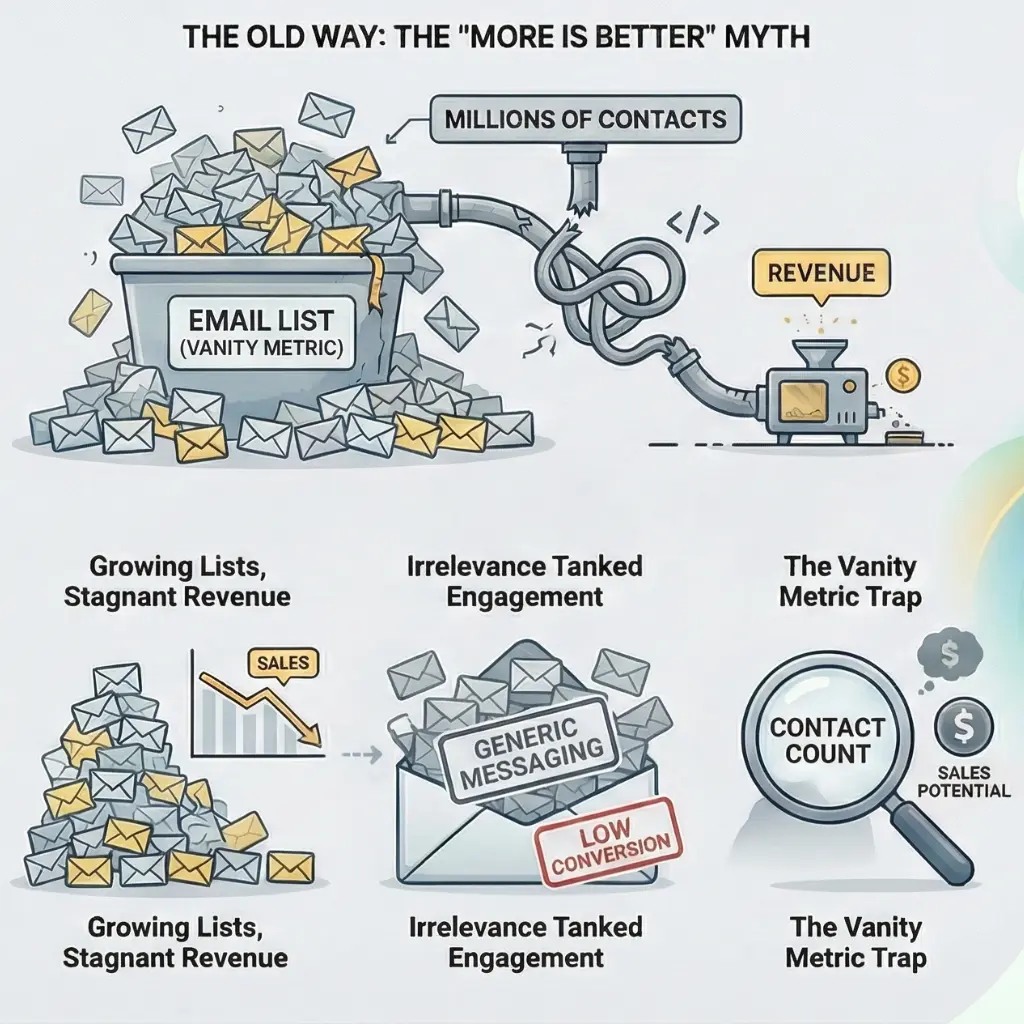
However, by the start of 2025, many brands started to face the same challenge: email lists were growing, but revenue was not keeping pace.
The reason was simple and clear: Traditional lists and the list-building strategies focused only on quantity. This may have worked during the times of the pandemic or up until 2024, but today, every business has figured out that more contacts don’t necessarily mean more sales.
Engagement and conversion rates depend on brand-customer relevance. And there was a decline in such metrics. Inbox competition increased, while tolerance for irrelevant messaging dropped.
In 2025, brands that survived and succeeded did one key thing differently: they shifted strategies. They stopped treating email list growth as a vanity metric and started treating it as a revenue channel.
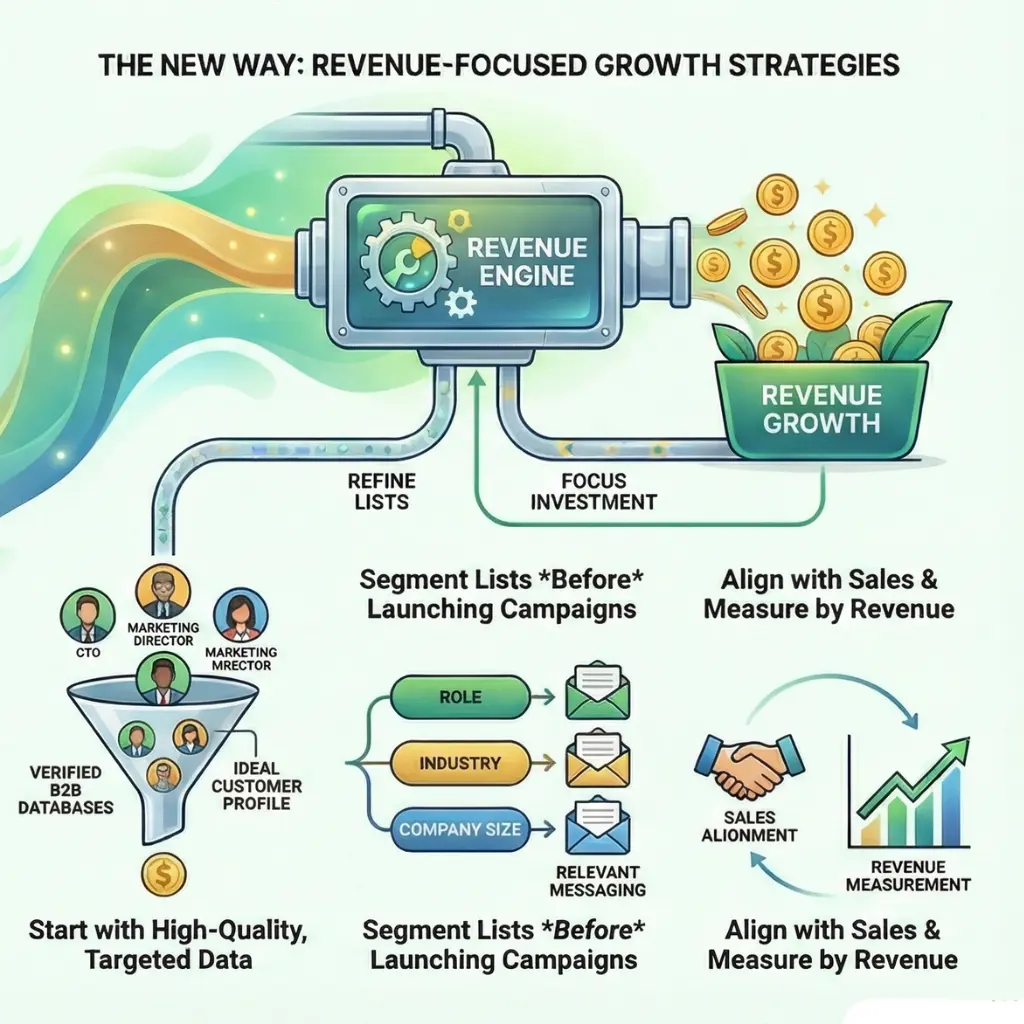
The use of targeted B2B email databases was the definitive strategy that allowed businesses to succeed in 2025. Instead of growing lists without proper segmentation, brands started to focus on adding contacts to the email lists who align with their ICP (Ideal Customer Profile).
These lists were either purchased from LakeB2B or built by sales teams around verified business email addresses, specific job roles, and clear industry alignments.
What made the difference was selectivity.
US brands that chose to purchase B2B email databases from LakeB2B or any other specialized providers saw better sales and ROI. This is because the data was selective and supported precision targeting.
Ultimately, the email lists created an impact and drove revenue. The roadmap was higher reply and demo request rates, faster sales follow-up cycles, and improved conversion.
In short, growth was controlled, not inflated.
Pre-campaign email list segmentation was another clear revenue driver for US B2B brands.
The idea was quite simple: instead of building a list and then segmenting it, high-performing brands designed segmentation logic before launching outreach. Businesses that partnered with LakeB2B opted for email lists that were organized by role, company size, industry, and more.
This approach was genius and eventually reduced wasted sends and improved relevance with prospects from the very first interaction emails.
Campaign data showed that segmented lists consistently outperformed broad sends in:
Brands with our structured B2B email database USA found sales and customer acquisition to be easier because the data already supported multi-layer segmentation.
Quality over Quantity. If decision-makers believe otherwise, it can all go haywire.
One of the most overlooked sales metrics in 2025 was the email address quality. The priority is finding or getting verified business email addresses. This is the factor that potentially delivered deals with highly qualified prospects.
Cleaner lists improved deliverability, which resulted in improved engagement and ultimately led to lead generation. Businesses also witnessed a boost in brand visibility and a better reputation by performing proper marketing etiquette.
So, the lesson is clear instead of treating data hygiene as maintenance, the brands that succeeded in 2025 used it as a growth filter. Only quality, valid, and verified contacts were added to active campaigns, and then the automation tools took care of the rest.
Brands made sure that there was no room for poor-quality data by working with trusted B2B email database providers. They found this approach easier to sustain, as data refresh cycles removed outdated or invalid contacts automatically.
Revenue-focused brands in 2025 treated email list growth as a joint effort between marketing and sales.
Instead of measuring success purely on open or click rates, marketers actively reviewed sales feedback on lead quality. Segments that consistently produced low-quality leads were refined or removed. Segments that converted well were expanded strategically.
This feedback loop helped brands identify which list growth efforts actually supported revenue.
Over time, this approach led to:
Regional and market-specific targeting within the USA allowed businesses to gain more customers and sales. Prospecting within your local verticals works way better than global outreach.
So, instead of relying on global datasets, brands prioritized B2B email databases USA that supported localized targeting.
Compliance with data regulations is also simpler when focusing on the US market first. This isn’t to suggest that global outreach is unnecessary or unwelcome; it’s simply that localized targeting enhances relevance and reduces friction during sales conversations for US brands.
Thus, businesses initially purchased USA email lists to tap into their local markets, driving revenue and building momentum for future global outreach.
Another strategy that consistently drove revenue was account-level list expansion.
Rather than adding more companies, brands focused on adding more relevant contacts within the same high-value accounts. Multiple stakeholders were targeted across departments, ensuring messaging reached decision-makers and influencers alike.
This approach worked especially well for businesses looking for more than just a sale; they got partnerships along with longer sales cycles.
Getting a well-segmented B2B email database was key to finding executive-level contacts. With the list, marketers also identified and added complementary roles within target accounts, strengthening engagement without broadening the audience unnecessarily.
By 2025, mature US B2B brands stopped evaluating email list growth using surface-level metrics like ‘the number of contacts available’.
Their marketing made more sense when they focused on getting email lists to find sales-qualified leads.
This mindset change influenced every growth decision because it supported sales and ultimately, revenue growth.
Contacts that had no relevance to the business, products, or services were never truly part of the campaign. This was made possible by LakeB2B’s targeted email lists. In essence, the true measure of growth today lies in the revenue contribution driven by a well-curated email list.
Growth strategies that showed a clear revenue link received more investment. This approach ensured email list growth remained sustainable and measurable.
One thing that remained as the core to all the mentioned strategies is data quality.
In order to achieve brand status, businesses needed to find relevant customers. Therefore, to get quality data, US businesses partnered with a reliable B2B data provider like LakeB2B. Here’s what they got from reputed providers:
Partnering with a data provider is what many B2B brands in the US have done. Instead of building, cleaning, or appending email lists, they opted to buy B2B email databases, recognizing them as essential assets for effective marketing.
The key takeaway from 2025 is that email list growth drives revenue only when it is specifically designed to do so.
If US brands had opted for any other marketing strategies, like just social media ads, the revenue growth may have been good, but not steady.
US brands that treated B2B email lists as a performance channel saw measurable gains. Those who continued to chase volume struggled to maintain engagement and conversion.
The difference was not budget or resources; it was strategy.
For B2B teams looking ahead, the lesson is clear: email list growth works best when it is designed to support revenue, not vanity metrics.
Achieve Greater Transparency and Enhanced Visibility in Reaching and Engaging with Ideal Customers
Submit the form below and our team will contact you.
 April 01, 2026 / 7 min read
By: Ajith D
 January 08, 2026 / 5 min read
By: John Williams
 January 06, 2026 / 11 min read
By: Bryan Scott