It’s Monday morning. Your SDR has a list of 40 “target accounts” in the CRM, one contact per company, and a sequence that sends the same three emails to all of them. By Friday, two replies came back. One was an out-of-office. The other was an auto-reply saying the VP had left the company in the spring.
That isn’t account-based selling. That’s a list with a nicer label. Account-based selling (ABS) works only when five things happen in order: you choose the right accounts, map the people who actually shape the decision, find a credible reason to engage now, coordinate outreach across the buying group and keep sales and marketing aligned until the account becomes pipeline.
Key takeaway: Account-based selling is not a bigger contact list. It is an operating model that moves an account from “good fit” to “sales-ready” through tiering, buying-group mapping, verified timing signals and coordinated multi-threaded outreach, measured at the account level.
What Is Account-Based Selling?
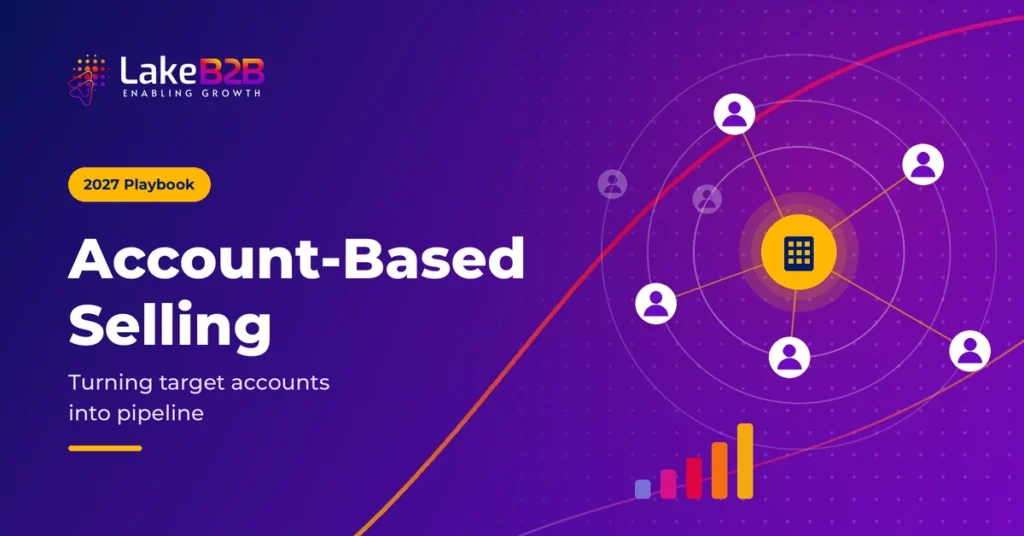
Account-based selling is a B2B sales strategy that concentrates coordinated, personalized sales effort on a defined list of high-fit companies. Instead of pursuing isolated leads, sales teams identify multiple stakeholders within each target account, understand their business priorities and engage the buying group to create and progress qualified opportunities.
The shift that matters is the unit of work. Traditional prospecting treats the contact as the unit. Account-based sales treats the company and its buying group as the unit, and the rep’s job becomes moving that whole group toward a decision.
That shift is now unavoidable. One champion, emailed three times, cannot carry a deal through a buying process like this:
A typical buying decision involves 13 internal stakeholders and 9 external influencers.
Source: Forrester, The State of Business Buying, 2026of B2B buying teams show unhealthy conflict during the decision process.
Source: Gartner sales survey, May 2025Account-Based Selling vs. ABM vs. Traditional Prospecting
| Dimension | Account-based selling | Account-based marketing | Traditional prospecting |
|---|---|---|---|
| Primary owner | Sales, with RevOps and marketing support | Marketing, in partnership with sales | Individual reps and SDRs |
| Starting point | Prioritized target-account list | Prioritized target-account list | Leads, lists, territories or inbound inquiries |
| Unit of focus | Company plus its buying group | Company or buying group as an audience | Individual lead or contact |
| Main work | Stakeholder mapping, direct outreach, discovery, deal progression | Targeted campaigns, content, ads, events, nurture | Research, calls, emails, follow-ups |
| Personalization | Account context plus role-specific value | Segment or account-level campaign content | Contact or persona level |
| Primary outcome | Qualified opportunities and closed revenue | Account awareness, engagement, influenced pipeline | Meetings and qualified leads |
| Core measures | Buying-group coverage, opportunities, pipeline, win rate, deal value | Account reach, engagement, influenced pipeline | Activity, connect rate, meetings, conversion |
ABS and ABM are partners, not rivals. Marketing builds familiarity across the account; sales works directly with stakeholders to uncover needs, navigate consensus and progress the deal. If you are building the marketing side, our guide to account-based marketing for enterprise sales covers that motion.
ABS is also not right for every deal. High-volume, low-value, transactional motions often run better on traditional prospecting or product-led acquisition. ABS earns its research cost when deal value, cycle length and stakeholder complexity are all high.
The rest of this playbook walks through a five-step model we call the Account-to-Pipeline Framework: Tier, Map, Time, Thread, Align.
Step 1, Tier: Build an Account-Based Sales Strategy on a Weighted ICP
Tier by fit and value first, then let timing signals reshuffle weekly priority, never the other way around. A high-intent account with poor fit should not jump ahead of a strong-fit account that is quiet this week.
Start from evidence about your best customers, not an industry hunch. Look at retention, expansion, deal size, cycle length and product fit, then translate the pattern into an ideal customer profile (ICP) built on three layers:
- Firmographic: industry and sub-industry, employee and revenue range, geography and footprint, business model, growth stage and recent business events.
- Technographic: current platforms, tool combinations that signal fit or integration needs, and recent adoptions or migrations. Reliable technographic data matters here, because a guessed tech stack produces a wrong pitch.
- Commercial: the problem you solve, ability to fund it, regulatory or security requirements, implementation complexity and your historical win/loss pattern.
Then score accounts rather than filter them. A long list of unranked filters treats every criterion as equally important, which it never is.
- ICP / firmographic fit (35%): Does the company look like your successful customers?
- Problem and use-case fit (25%): Is there a credible problem you can solve?
- Technographic fit (15%): Does its tech environment create fit or a trigger?
- Timing / intent signals (15%): Is there a recent, attributable reason to act now?
- Commercial potential (10%): Is the likely contract value worth the effort?
A Three-Tier Account Model
Highest fit, meaningful value, strong trigger or strategic importance.Deep research, bespoke account plan, 4 to 8+ stakeholders, coordinated sales and marketing plays.
Strong fit, moderate value or weaker timing.Role-based personalization, 3 to 5 stakeholders, signal-triggered sequences.
Core fit, lower value or limited timing evidence.Automated research and enrichment, segment messaging, selective human follow-up.
Treat the account counts as planning hypotheses. A high-value enterprise motion may support fewer than 10 strategic accounts per rep; a mid-market motion may support far more. Test capacity against real research time, meeting load and conversion data, and shrink the list the moment account plans stop being genuinely personal.
Step 2, Map: Chart the Buying Committee and Verify Every Contact
The most senior person on the org chart is rarely the only person who decides, and a contact record you cannot trust is worse than no record at all. Map who approves, evaluates, implements, uses and could block the purchase.
| Buying role | What they care about | What sales should establish |
|---|---|---|
| Economic buyer | Budget, business case, risk, return | Funding path, measurable impact, approval criteria |
| Champion | Solving the problem, gaining internal support | Personal motivation, influence, willingness to mobilize others |
| Technical evaluator | Security, integration, architecture, performance | Technical requirements, proof, integration constraints |
| Functional owner | Workflow, operational results, team impact | Current process, pain points, desired outcomes |
| End user | Usability, adoption, daily impact | Practical workflow and adoption barriers |
| Procurement, legal, finance | Terms, vendor risk, compliance | Approval sequence, documentation, contract needs |
| Potential blocker | Risk, change impact, competing priorities | Specific objections and the evidence that resolves them |
Role labels vary by company, and one person can hold several. “Champion” describes behavior and influence, not a job title, so never infer authority from seniority alone.
Forrester’s 13-stakeholder finding supports a broader map. It does not mean a rep should cold-contact 13 people. Identify the relevant group and plan role-appropriate engagement.
Minimum Fields for Every Contact Record
- Full name, current job title, department and seniority
- Company name and canonical company domain
- Business email with verification status and date
- Business phone, only if lawfully sourced and appropriate
- Likely buying role and relationship to other stakeholders
- Source (URL or provider) and date last checked
- Consent, suppression or do-not-contact status where applicable
A Six-Step Verification Workflow
- Resolve the company to its canonical domain and legal or business identity.
- Find people through public company sources, permitted professional data providers or licensed databases.
- Confirm current title and company against a recent source.
- Validate the work email with a verification service, and separate syntax or domain checks from mailbox-level confidence.
- Record provenance, verification date and confidence. A “verified” label today guarantees neither deliverability next quarter nor that this is the right buyer.
- Recheck before any high-value play, and suppress bounced, opted-out or restricted contacts.
If leadership roles are the gap in your map, this walkthrough on how to find company leadership contacts covers the research side, and a US business executives email list can help fill executive-level gaps.
Step 3, Time: Use Business and Intent Signals for Account-Based Prospecting
A signal tells you where to look this week; it never tells you the account is ready to buy. Treat every trigger as a hypothesis to research and qualify, then combine it with ICP fit and real discovery.
Timing matters because buyers move early and quietly. The 2025 Buyer Experience Report from 6sense describes buyers who often shortlist vendors before contacting sellers. Your job is to be useful and credible before the hand-raise, not to force an account into market.
| Signal | Example evidence | Sales hypothesis | Qualification question |
|---|---|---|---|
| Hiring | Several open roles in a relevant function | Growth may create process or tooling needs | A new initiative or a routine backfill? |
| Funding or acquisition | Funding round, acquisition, new investment | New budget or integration work | Has it created a funded priority tied to your use case? |
| Technology change | Adoption, migration or replacement | Integration, consolidation or capability gap | Is the change confirmed and relevant? |
| Leadership change | New CIO, CRO, CMO or function head | New priorities or a vendor review | What will this leader change, and when? |
| Geographic expansion | New offices or market entry | New demand or compliance needs | Which teams and budgets are affected? |
| First-party engagement | Key page visits, event attendance, demo request | Interest may be rising | Who engaged, with what, and did they ask for contact? |
| Third-party intent | Repeated research on a category | Problem exploration may be underway | Is it account-level, recent and specific enough? |
The Signal Quality Check
Before a signal changes a rep’s week, run it through six questions:
- Source: can you trace it to a primary or reputable source?
- Recency: when did the event happen, not just when was it collected?
- Relevance: does it connect to the buyer’s problem and your use case?
- Specificity: is it a company event or generic category noise?
- Corroboration: is there a second signal or direct confirmation?
- Decay: when should it stop influencing priority?
Pairing firmographic fit and B2B intent data is what keeps a burst of category research from a poor-fit company out of your Tier 1 queue.
Step 4, Thread: Run Multi-Threaded Outreach Across the Buying Group
Multi-threading is not sending the same email to more people; it is one account conversation in which each stakeholder gets their own reason to engage. Keep a single account-level hypothesis and tailor the business impact to each role.
That matters most when the buying group disagrees. If nearly three-quarters of buying teams experience unhealthy conflict, as Gartner’s survey found, the seller who helps the group build consensus with role-relevant information wins more often than the seller who simply sends more.
An Illustrative 14-Day Cadence
| Day | Channel | Action | Purpose |
|---|---|---|---|
| 1 | Concise, role-specific note to the most relevant first contact, citing one verified account trigger | Establish relevance | |
| 2 | Review public profile and company info; follow or engage manually, no scraping or mass connecting | Build context | |
| 3 | Phone | Call if a lawful business number exists; leave a short, useful voicemail | Add a human channel |
| 5 | Send a follow-up with a new insight, question or resource, never “just checking in” | Add value | |
| 6 | Engage authentically with relevant company content | Build familiarity | |
| 8 | Phone | Second call at a different time | Test reachability |
| 9 | Reach out to a second stakeholder with a role-specific hypothesis | Begin multi-threading | |
| 11 | Email or content | Proof point, checklist or case study matched to the role | Reduce perceived risk |
| 13 | Phone | Final call to the primary or an alternate contact | Seek a clear next step |
| 14 | Close-the-loop note with a respectful opt-out; move to nurture if silent | End responsibly |
This is a starting template, not a benchmark. Test length, timing and channel mix against qualified meetings and pipeline, not raw activity.
Rules That Keep the Cadence Credible
- Stop or pause the moment you get a reply, a booked meeting, an opt-out, a hard bounce or a clear “not interested.”
- Coordinate touches so two stakeholders never get near-identical messages on the same day.
- No fake referrals, misleading subject lines or fabricated personalization. Never imply internal knowledge you do not have.
- A profile view, job change or intent topic is not consent to contact.
- Follow the privacy, email and telemarketing rules of the recipient’s jurisdiction. In the US, start with the FTC’s CAN-SPAM compliance guide, and respect LinkedIn’s rules on prohibited automation and extensions.
The First-Touch Email in Six Parts
Step 5, Align: One Account List, One Owner, One Handoff
A shared account list is necessary but not sufficient; without shared definitions and handoff rules, sales and marketing either collide on the same accounts or both assume the other is working them. Agree on eight operating rules before launch:
- One canonical target-account list in the CRM or agreed system of record.
- A visible account owner, plus the supporting SDR, AE and marketing owner.
- Tier, ICP score, active trigger, buying-group map and last-reviewed date on every account record.
- Marketing defines which engagement signals count as meaningful.
- Sales defines acceptance criteria and follow-up service levels.
- Marketing gets disposition feedback: accepted, working, nurture, disqualified or existing opportunity.
- Open opportunities and customer accounts are protected from conflicting prospecting.
- A weekly account review resolves ownership, duplicate outreach and next actions.
Example Handoff Rule
When a Tier 1 or Tier 2 account shows a meaningful first-party engagement or a verified business trigger:
- RevOpsChecks ownership and suppression rules.
- SDRReviews the context.
- SalesAccepts or rejects, with a reason.
- MarketingPauses conflicting automation and supports the agreed play.
Base the response SLA on your team’s capacity and the buyer’s urgency, not on a number borrowed from someone else’s playbook.
The Account-Based Selling Scorecard: Metrics That Prove Pipeline
Measure accounts, not activity, and connect every number to pipeline or revenue. Drop email opens as a primary signal: privacy protections and mail-client behavior make them an unreliable proxy for interest.
| Metric | Formula | What it tells you |
|---|---|---|
| Target-account coverage | Target accounts with at least one relevant contact ÷ total target accounts | Whether the list is actionable |
| Buying-group coverage | Mapped stakeholders with usable, current records ÷ estimated relevant stakeholders | Your single-threading risk |
| Multi-threaded account rate | Engaged accounts with 2+ stakeholders engaged ÷ engaged accounts | Breadth of engagement |
| Account engagement rate | Accounts meeting a pre-defined engagement threshold ÷ accounts reached | Account-level response |
| Account-to-opportunity conversion | Accounts creating qualified opportunities ÷ accounts actively worked | Whether the program creates pipeline |
| Pipeline created | Sum of qualified opportunity value sourced from target accounts | Commercial contribution |
| Pipeline velocity | Opportunities × average deal value × win rate ÷ average cycle length | Throughput (keep units and periods consistent) |
| Win rate by tier | Won ÷ closed opportunities, per tier | Whether your tiering predicts outcomes |
| Average contract value by tier | Closed-won value ÷ closed-won deals, per tier | Economic value of prioritization |
| Data freshness | Records reviewed within your freshness window ÷ records in active account plans | Contact-data quality as an operating metric |
Measurement Safeguards
- Define “engaged” before you report. A single open never qualifies.
- Separate sourced pipeline from influenced pipeline, and write down the attribution rules.
- Report by tier, segment, region and sales motion.
- Compare cohorts over a meaningful period, with the same denominator and time window.
- Track data quality separately from sales performance, so a bad list is not mistaken for a bad rep.
There is no universal ABS benchmark worth copying. Use these formulas to set your own baseline in the first quarter, then improve against it.
10 Mistakes That Quietly Kill Account-Based Sales Programs
Most ABS programs fail on operations, not strategy: too many accounts, too few verified contacts and no shared ownership.
| Mistake | Prevention |
|---|---|
| Targeting too many accounts | Start with a pilot, measure workload and expand only while plans stay personal |
| Single-threading | Map the buying group and build relationships across roles |
| Confusing fit with timing | Score fit and timing separately |
| Treating weak intent as buying proof | Corroborate signals and confirm in discovery |
| Stale or unverified contacts | Track source, date and verification status on every record |
| Identical messages to every stakeholder | Keep one account hypothesis, tailor value by role |
| No shared ownership | Define CRM ownership and handoff states |
| Optimizing for activity | Measure engagement, qualified opportunities and revenue |
| Over-automating Tier 1 | Use automation for research and coordination, not judgment |
| Ignoring compliance and platform rules | Build suppression, disclosures and permitted sourcing into the workflow |
Frequently Asked Questions
Is account-based selling the same as ABM?
No. Account-based selling is the sales-led process of engaging stakeholders inside target accounts and progressing opportunities. Account-based marketing is the marketing-led process of building awareness and engagement with those accounts through campaigns, content and events. They work best when they share account priorities, signals and reporting.
How many target accounts should a sales rep have?
There is no universal number. It depends on deal value, cycle length, account complexity, stakeholder count and research time. A strategic enterprise rep may run a small set of deeply researched accounts, while a scaled motion supports more. Start with a pilot and check whether account plans stay genuinely personal.
What tools do you need for account-based selling?
Most teams need a CRM as the system of record, reliable company and contact data, an enrichment and verification workflow, a sales engagement tool, business-event or intent signals where useful, and shared reporting. An account-based selling platform adds value only if the team can verify records, map stakeholders, coordinate outreach and tie activity to pipeline.
What is an account-based sales development rep?
An account-based SDR or BDR researches and prioritizes target companies, identifies relevant stakeholders, personalizes outreach with account context, coordinates multi-threaded engagement and qualifies opportunities for account executives. The role is measured on account progression and qualified pipeline, not on the number of contacts or emails produced.
Should every B2B company use account-based selling?
No. It fits best when accounts carry meaningful value, complex buying groups, longer evaluation cycles or strategic importance. High-volume, low-value or transactional motions are often more efficient with traditional prospecting or product-led acquisition.
How is account-based selling measured?
Track account coverage, buying-group coverage, multi-threaded engagement, account-to-opportunity conversion, qualified pipeline and pipeline velocity, plus win rate and average contract value by tier. Define engagement and attribution consistently, and do not use email opens as the main success metric.
From Target List to Pipeline: Where 2027 ABS Programs Win
The teams that win with account-based selling in 2027 will not be the ones with the longest account lists or the busiest sequences. They will be the ones whose reps know, for every Tier 1 account, who sits in the buying group, which of those people they can reach today, and why this quarter is the right one to start.
Every step of the Account-to-Pipeline Framework runs on the same input: accurate account and contact intelligence. Tiering needs firmographic and technographic fit. Mapping needs current, verified buying-committee contacts with clear provenance. Timing needs business events you can trace to a source. When that layer is weak, AI-assisted research and sequencing simply scale the mistakes faster.
That is the layer LakeB2B supports: firmographic fit for target-account lists, technographic context, buying-committee contact discovery, plus enrichment with transparent source and verification status, so your reps spend their time selling instead of rebuilding records. Teams that want to start from the data side can explore the B2B lead finder.