Physician Email Marketing in 2027: How to Reach Doctors Who Ignore 90% of Their Inbox
Summarize with AI
|
Getting your Trinity Audio player ready...
|
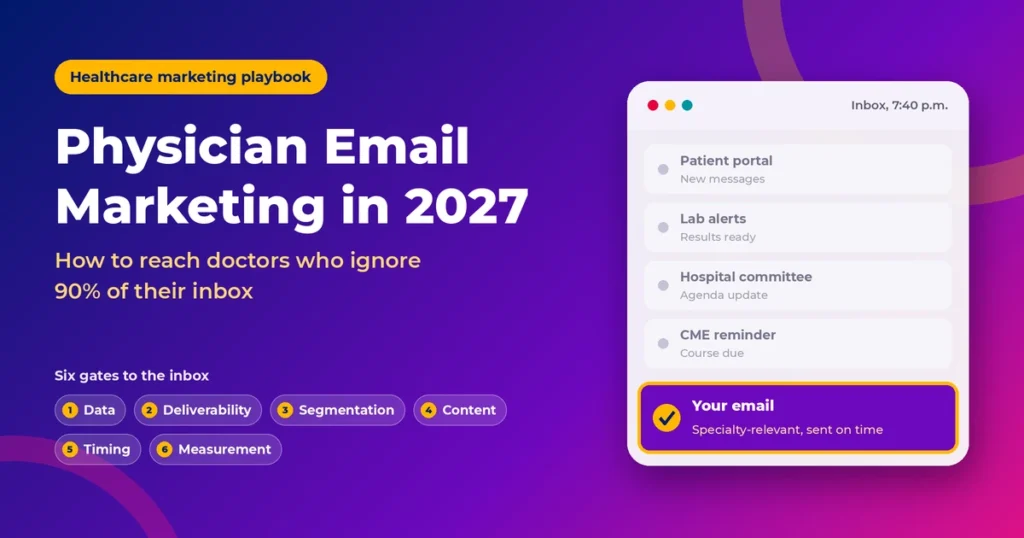
It’s 7:40 p.m. A cardiologist finally sits down to clear her inbox after clinic. Near the bottom sits your email, which opens with “Dear Doctor, we are a leading provider of innovative solutions.”
She doesn’t read it. Not because she hates email, but because nothing in the first line told her why it mattered to her tonight.
Patient portal: new messages
Lab alerts: results ready
Hospital committee update
Two CME reminders
“Dear Doctor, we are a leading…”
That’s the real story behind “doctors ignore 90% of their inbox.” No study has measured that exact figure, and we won’t pretend one has. It simply describes how commercial email feels from a physician’s side of the screen. Doctors still want useful email; they just give it about three seconds to prove it.
Physician email marketing works in 2027 when you send fewer, specialty-specific emails, triggered by a real professional action, from an authenticated domain, to verified physician data. Relevance, not volume, is the strategy.
Doctors Aren’t Ignoring Email. They’re Ignoring Irrelevant Email
Physicians use email for professional information, but they ration their attention carefully. In the Physician Communications Report 2024, 78% of surveyed doctors ranked email first or second for information relevant to their clinical roles.
Email is a welcome channel. But preference is not permission, and it isn’t attention either. Your real competition is the rest of the inbox:
- Patient messages. KLAS Arch Collaborative’s Message Burden 2025 report found that 60% of messages reaching ambulatory physicians in its early sample came from patients.
- Sheer volume. A peer-reviewed single-physician inbox study counted 9,102 emails in a year, about 25 a day. It covers one doctor, so treat it as a case study.
- Admin mail. Committee updates, compliance notices and scheduling all land in the same place.
Your email isn’t competing with other vendors. It’s competing with a patient who needs an answer.
To survive the three-second scan, your email must quickly answer at least one of these questions:
- Is this about my specialty?
- Does it help a clinical, operational or financial decision?
- Is the sender credible?
- Why now?
Healthcare Email Marketing Benchmarks: What “Good” Looks Like
The Numbers: IQVIA’s analysis of more than 236 million HCP emails found that triggered campaigns reached an 18.26% open rate and a 3.43% click-to-open rate, outperforming broadcast sends, even as send volume grew 47% year over year.
Emails sent because a physician did something beat emails sent because it was Tuesday. Results also vary widely by sender type, as Benchmark Email’s 2026 category figures, reported by Signal Hill Strategies, show:
| Sender category | Open rate | Click rate | Unsubscribe rate |
|---|---|---|---|
| Medical devices | 22.58% | 0.11% | |
| Hospitals and health care | 21.44% | 0.10% | |
| Medical practice | 40.89% | 0.11% | |
| Pharmaceuticals | 12.71% | 0.03% | |
| All industries | 25.54% | 0.10% |
Read these numbers with care. They measure senders, not physician recipients. Open rates are inflated by Apple Mail Privacy Protection, as MailerLite notes.
Use benchmarks to sanity-check a pilot, never as a target.
The Earned Inbox Framework: Six Gates Every Physician Email Must Pass
Winning physician email is not one tactic. It’s six gates in a row, and failing any one wipes out the work of the others. A brilliant subject line can’t save an email that bounced.
- DataRight physician, right address?Fails as: bounces, wrong specialty
- DeliverabilityWill it reach the inbox?Fails as: spam folder
- SegmentationDoes it fit their specialty and role?Fails as: “Dear Doctor” copy
- ContentIs it worth three seconds?Fails as: opens without clicks
- TimingWhy now, and how often?Fails as: unsubscribes, complaints
- MeasurementDid it create a real outcome?Fails as: optimizing for fake opens
A common trap is fixing a Gate 1 or Gate 2 problem by rewriting subject lines at Gate 4.
Gate 1Build Your Physician Email List on Data You Can Defend
Your data decides your results before a word is written. The CMS NPPES NPI Registry is the main public source for identifying US providers by name, specialty taxonomy and practice location, with a daily-refreshed API. It’s ideal for identity matching and specialty segmentation, but it contains no email addresses, doesn’t prove a current license and grants no marketing permission.
Most teams enrich NPI identity with professional emails from an HCP data provider. Before you buy a physician email list, ask for:
- Source and collection method for each record
- Last verified date, by record and by field
- What “verified” means: syntax, domain, mailbox or engagement
- Coverage by specialty, state and practice type
- Rates of duplicate, catch-all, role-based and invalid addresses
- Evidence of lawful collection and permitted use
- Opt-out and suppression procedures
- A sample file you can test before committing
“Email verified” and “physician consented” are two different things.
On each record, keep the NPI, specialty, affiliation, email source, last verified date, consent record, preferences and suppression status. Keep patient-level health information out entirely.
Gate 2Email Deliverability for Healthcare Senders Is Non-Negotiable
If your domain isn’t authenticated, your email never gets the chance to be ignored. It simply disappears. Google requires SPF or DKIM, valid DNS, TLS and a spam rate below 0.3%. Senders of more than 5,000 messages a day need the full stack:
- SPFAuthorizes your sending servers
- DKIMSigns every message
- DMARCAligns your From domain
- TLSEncrypts delivery
- 1-clickUnsubscribe in the header
Yahoo sets similar rules and asks bulk senders to honor unsubscribes within two days. Hospital mail filters judge reputation too, so treat these rules as your floor.
Your 2027 deliverability checklist
- Exactly one SPF record, plus DKIM on every sending platform
- DMARC at p=none first, tightened after reviewing reports
- A visible unsubscribe link in the email body
- Gradual warm-up for new domains and IPs
- Immediate suppression of hard bounces, and re-verify older records before large sends
- One global suppression list across every tool and agency
Authentication gets you to the door; low complaints and clean data get you invited back.
Gate 3Segment by Specialty, Setting and Role
An oncologist and a dermatologist share a degree, not an inbox priority. Segment on four layers:
- SpecialtyCardiology wants evidence updates and referral pathways; radiology wants imaging workflow and AI tools; primary care wants efficiency.
- Practice settingAn independent practice owner buys very differently from a physician inside a health system.
- RoleClinicians care about evidence and usability, practice owners about revenue and staffing, and executives about ROI.
- Relationship stageOpted in, engaged, high intent, inactive or suppressed.
In enterprise healthcare, the physician is often the user or champion, not the budget owner, so don’t send every doctor a “book a demo” button.
Gate 4Write Emails Doctors Actually Read
Lead with a specific professional problem, not your company. Compare:
Both are commercial, but only the second gives a radiologist a reason to keep reading. Build every email on the same six parts, short enough to scan on a phone:
- SenderA real person or trusted organization
- Subject lineAccurate and specific to the content
- Opening lineNames their specialty or role
- Insight and proofOne useful idea, backed by evidence
- One CTARead, register, reply or request
- FooterSender identity, postal address, unsubscribe
Subject lines for doctors: specific beats clever
“Your requested slides from [webinar name]”
A deceptive subject line might win one open, but it loses the physician and can breach CAN-SPAM.
Gate 5Send When Physicians Act, Not When Your Calendar Says So
Triggered emails answer “why now?” for you. Good triggers are clear professional actions: a webinar registration, a request for an evidence summary, a guide download, a demo request or a newsletter opt-in. Never infer sensitive health information from browsing data.
Example: a webinar follow-up sequence
- Right awayConfirmation and calendar invite
- 1 day beforeShort reminder and agenda
- 1 day afterSlides and promised resources
- 3 to 5 days afterOne related resource
- 10 to 14 days afterOptional conversation invite
Stay within what the registration notice promised. How often should you email doctors? No universal rule exists. A sensible starting test is one or two useful emails a month, plus triggered follow-ups, adjusted by specialty. Test the best time to email physicians against your own segments, too.
The best programs don’t send more; they send at the moment a doctor has already raised a hand.
Gate 6Measure Qualified Outcomes, Not Open Rates
Open rate is the least reliable number in your report. Rank your metrics in this order:
- Qualified conversions
- Unique clicks
- Positive replies
- Meeting or demo requests
- Delivered and bounce rates
- Spam complaints
- Unsubscribes
- Opens (directional only)
Filter out bot clicks and track conversions in your CRM. Test one variable at a time: clinical evidence versus workflow angle, company sender versus a named person, or triggered versus broadcast. AI can speed up segmentation, content variants and reply routing, but a human must approve every clinical claim, and no patient data belongs in general-purpose AI tools.
AI multiplies the quality of your data, good or bad, and your pilot is your only real benchmark.
CAN-SPAM and HIPAA: What Applies to Email Marketing to Doctors
This is a marketing operations overview, not legal advice.
The FTC confirms it applies to commercial business email, and a doctor’s work address creates no exemption.
- Honest headers
- Non-deceptive subject
- Postal address
- Working opt-out
- Opt-outs within 10 business days
The Privacy Rule governs protected health information held by covered entities and their business associates. A physician’s professional contact record isn’t automatically PHI, but patient lists, appointments or treatment data must never be repurposed for marketing without a valid legal basis.
Also check state privacy laws, FDA rules on product claims, TCPA if you add SMS or calls, and GDPR for recipients outside the US.
Frequently Asked Questions
Is email still an effective way to reach physicians in 2027?
Yes, when it’s relevant. In a 2024 survey, 78% of doctors ranked email as their first or second preferred channel for professional information.
What is a good open rate for physician email marketing?
There’s no single benchmark. Healthcare sender categories range from about 12.7% to 40.9%, and IQVIA reported 18.26% for triggered HCP campaigns. Focus on clicks and conversions instead.
Is HIPAA a barrier to emailing doctors?
Not for a physician’s business email alone. HIPAA restricts the use of patient health information in marketing.
Can I get physician email addresses from the NPI Registry?
No. It provides identity, specialty and location, but no emails and no marketing permission.
Earn the Inbox Before You Fill It
That cardiologist wasn’t ignoring email; she was filtering for the few messages that clearly belonged to her specialty, her role and her week. The 2027 opportunity is sending fewer, sharper emails that pass all six gates.
Every gate depends on the first. If the specialty is wrong or the address bounces, nothing downstream can recover it. Your physician email program is only as good as the physician data underneath it. That’s the layer LakeB2B focuses on: healthcare provider data with the specialty, affiliation and verification details you need to segment and govern.
Put your physician data to the test
Get a free sample of physician records for your target specialty and run it against the Gate 1 checklist.
Request a free physician data sampleTable of Contents
Ready to turn insights into pipeline?
LakeB2B helps you find, enrich, and connect with verified B2B contacts using accurate data, intent signals, and audience intelligence so your sales and marketing teams can reach the right decision-makers with confidence.