To generate B2B leads that actually convert in 2026, stop optimizing for lead volume. Build a system that earns buyer preference before first contact, detects intent early, engages the whole buying group, and measures success in qualified pipeline. The 12 strategies below show you how, backed by the latest research.
In 2025 study of more than 4,000 B2B buyers, 94% of buying groups had already ranked their preferred vendors before first contact with a seller. The vendor in first place went on to win roughly four out of five deals. So by the time a form fill lands in your CRM, most of the lead generation work has already been won or lost.
That changes what “generating leads” means. The teams building real pipeline in 2026 are not the ones capturing the most contacts. They are the ones who are visible before buyers identify themselves, quick to recognize buying signals, present across the whole buying group, and disciplined about what happens after the lead appears.
Stop optimizing for lead volume. Build a system that earns preference before buyers raise a hand, detects intent early, engages the full buying group, and measures success in qualified pipeline and revenue.
B2B Lead Generation in 2026: What Changed and Why It Matters
The buyer journey moved upstream, into places your forms cannot see. Four shifts in the latest research explain why the last decade’s lead generation playbook is underperforming.
1. Buyers choose before they talk. Beyond the 94% shortlist figure, 6sense reports an average buying cycle of around 10 months. Most of that time is self-directed, anonymous research. Your content, reviews, peer reputation, and AI visibility do the selling long before a rep gets involved.
2. AI assistants joined the research process. In the same 6sense research, 94% of B2B buyers said they used large language models during their buying journey. Demandbase measured ChatGPT-referred visits to B2B websites in its network rising from about 645,000 in June 2025 to 2.6 million in June 2026, a 303% year-over-year increase.
3. Everyone has the same tools now. The Content Marketing Institute’s 2026 research found that 97% of surveyed B2B marketers have a content strategy and 95% use AI tools. When everyone can produce content cheaply, generic content stops differentiating anyone.
4. Outbound got less forgiving. Belkins analyzed 7.53 million cold emails sent in 2025 and found a 0.45% average reply rate when replies are divided by total sends. Volume alone no longer buys pipeline.
The numbers: According to 6sense’s 2025 Buyer Experience Report, roughly 4 in 5 deals go to the vendor the buying group preferred before first contact. If your brand is not on the shortlist early, sales rarely gets a fair chance to fix it later.
Source: 6sense, 2025 Buyer Experience Report
How We Chose These 12 B2B Lead Generation Strategies
“Proven” here means supported by recent behavioral data, benchmark evidence, and repeated B2B practice. It does not mean guaranteed results.
We prioritized 2025 and 2026 primary research from the organizations that own the data over statistic roundups that recycle older numbers. We favored large samples and behavioral data over opinion, and pipeline indicators over surface metrics like opens and impressions.
A few honest caveats before you apply any benchmark in this article:
- Vendor numbers describe their own customers. ON24’s webinar figures describe ON24 users. Belkins’ outreach figures describe Belkins-run campaigns. Demandbase’s traffic figures describe its own network. None of them is a universal market average.
- Survey data is self-reported. Treat CMI and LinkedIn figures as what marketers report doing, not as controlled experiments.
- Definitions differ. A “reply,” a “conversion,” and an “opportunity” mean different things in different studies. Never compare them as if they were the same metric.
- Your context changes everything. Industry, deal size, region, and buying complexity all shift performance. Your own baseline beats any industry average.
The 4-Layer Pipeline System: 12 Strategies at a Glance
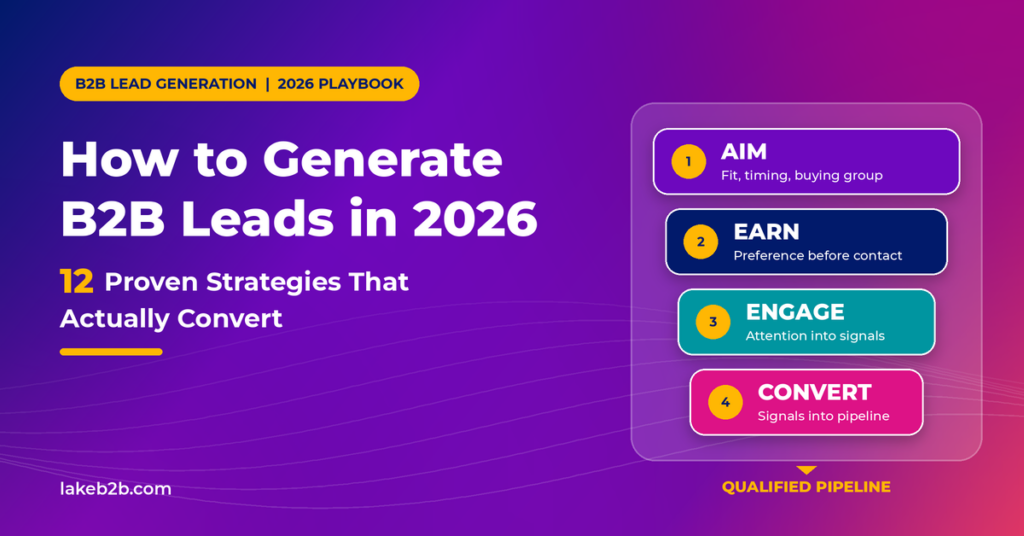
Every strategy below fits into one of four layers, and a weakness in any layer caps the output of the others. Aim decides who you pursue. Earn builds preference before contact. Engage converts attention into buying signals. Convert turns signals and outreach into qualified pipeline.
| Layer | # | Strategy | What it should produce | Metric that proves it |
|---|---|---|---|---|
| Aim | 1 | Tight ICP with trigger-based segments | Accounts that fit and have a reason to act now | Pipeline per 100 target accounts |
| Aim | 2 | Buying-group ABM | Coverage across the people who decide | Buying-group depth per account |
| Aim | 3 | First-party intent scoring | A ranked list of who to contact first | Opportunity rate by score band |
| Earn | 4 | SEO plus AI search visibility | Presence on shortlists during research | Organic and AI-assisted pipeline |
| Earn | 5 | Original research and thought leadership | Citations, links, and executive attention | Content-assisted opportunities |
| Earn | 6 | LinkedIn video and expert voices | Trust and recognition before outreach | Target-account engagement |
| Engage | 7 | Webinars and micro-events | Rich behavioral intent signals | Attendee-to-meeting conversion |
| Engage | 8 | Interactive lead magnets | Qualification data that buyers volunteer | Completion-to-meeting rate |
| Engage | 9 | Paid demand capture and retargeting | High-intent conversions from warm audiences | Cost per qualified meeting |
| Convert | 10 | Precision cold email | Relevant conversations with the right accounts | Positive reply and meeting rate |
| Convert | 11 | Multi-channel outbound | Reaching buyers where they actually respond | Sequence-level meeting rate |
| Convert | 12 | Conversion operations | Leads that become revenue instead of leaking | Stage-to-stage conversion |
Layer 1, Aim: Target B2B Leads by Fit, Timing, and Buying Group
Broad targeting makes every channel downstream more expensive. Before you write a single email or publish a single page, decide which accounts deserve your effort and why now.
1Tighten Your ICP and Build Trigger-Based Segments
Fit tells you who could buy. Triggers tell you who may care right now.
Most ideal customer profiles are written in a workshop from assumptions: industry, headcount, and revenue band. That describes who could buy, not who is likely to buy this quarter. Forrester’s 2026 Demand and ABM guidance pushes teams away from lead-centric targeting toward account and buying-group programs, and that starts with a sharper definition of the account.
Build your ICP from revenue evidence, not opinion:
- Closed-won customers, especially those with the fastest sales cycles
- Customers with the highest retention, margin, or expansion
- Shared patterns in industry, company size, technology stack, use case, and job roles
- The recurring “why now?” moment that preceded each purchase
Then layer on triggers that signal timing. The strongest include new funding, a new executive in the buying function, rapid hiring in a relevant team, expansion into a new market, a new compliance requirement, a technology migration (which technographic data can surface), an acquisition, job postings that reveal priorities, signs of dissatisfaction with a competitor, and repeated high-intent visits to your site.
2Replace Single-Lead Targeting With Buying-Group ABM
One form fill is not an opportunity. A buying group engaging together is.
Modern B2B purchases involve finance, IT, security, operations, and an executive sponsor, not just the person who downloaded your ebook. Forrester’s 2026 guidance explicitly recommends buying-group-centric marketing over contact-by-contact programs. And because 6sense shows that preference forms before first contact, awareness has to reach the whole account before anyone raises a hand.
Tier your accounts so personalization matches value:
- Tier 1: A small set of the highest-value accounts, with deep, account-specific personalization and coordinated sales plays.
- Tier 2: Segment-level personalization by industry or use case.
- Tier 3: Programmatic targeting with lighter personalization.
Then map the roles that typically decide: the economic buyer, champion, technical evaluator, security or compliance reviewer, finance or procurement, end users, and the executive sponsor. Build role-specific landing pages, run multi-persona ad creative, host account-specific workshops, and retarget multiple people inside engaged accounts. For a deeper walkthrough, see our guides to what account-based marketing is and ABM tactics for high-value accounts.
3Activate First-Party Intent With Behavioral Lead Scoring
You probably already collect the signals that matter. The gap is acting on them.
CMI’s 2026 research found that 91% of B2B marketers collect first-party data, while governance and sophistication remain uneven. Adding another data source will not fix that. Prioritizing what you already see will.
The highest-value first-party signals are commercial, not educational: pricing page visits, comparison page visits, integration documentation reads, security and compliance page views, repeat visits from one account, webinar questions and CTA clicks, product trial activity, several people from one account visiting, and a return visit shortly after outbound contact. Pair them with third-party signals where you have them; our breakdown of ABM and intent data explains how the two work together.
Replace one opaque lead score with three dimensions, the same logic behind predictive analytics for B2B list targeting:
- Fit score: industry, size, geography, role, and technology environment
- Intent score: page type, recency, frequency, event actions, and product activity
- Buying-group score: number of engaged stakeholders, seniority and function coverage, and the account-level engagement trend
A practical model is Fit × Intent × Buying-group depth. An account that fits, is visiting your pricing page, and has four people engaged is a very different priority from a single student downloading a guide.
Layer 2, Earn: Build Buyer Preference Before the First Conversation
If most buyers shortlist vendors before contact, the content they find during research is your real first sales call. This layer is where brand, expertise, and discoverability turn into shortlist placement.
4Win High-Intent Search and AI Search Visibility
SEO is not dead. Discovery is diversifying, and your pages need to be citable, not just rankable.
With 94% of buyers using LLMs during their journey and ChatGPT referrals to B2B sites up 303% year over year in Demandbase’s network, AI assistants are now a real discovery channel. But Demandbase’s data also shows that AI referrals remain a small share of total site traffic. The right conclusion is to optimize for search engines and AI assistants, not to abandon one for the other.
Prioritize commercial-intent content before scaling top-of-funnel traffic:
- “[Category] software” and “best [category]” pages
- “[Product A] vs [Product B]” comparisons and “[Competitor] alternatives”
- Pricing and cost pages, or at minimum clear pricing logic
- Implementation timelines, ROI, and business case content
- Integration, security, and compliance pages
- Migration guides and industry-specific use cases
- FAQ pages that answer evaluation-stage questions directly
To earn citations in AI answers, publish clear, factual answers, lead with original data and first-hand expertise, make product claims easy to verify, earn mentions from trusted third-party sources, and keep capability, pricing, integration, and policy pages current. Track AI referral traffic as its own segment in analytics, and manually check the prompts buyers would use to compare vendors in your category.
5Publish Original Research and High-Trust Thought Leadership
When 95% of marketers use AI to create content, the only defensible content is what AI cannot generate: your data and your judgment.
CMI’s 2026 research found that 96% of B2B marketers create thought leadership, yet comparatively few manage it effectively at scale. Meanwhile, CMI’s 2025 figures show that content generated demand or leads for 74% of B2B marketers overall and 89% of the most successful. The difference is not volume. It is substance.
Formats that consistently generate leads include annual benchmark studies, industry surveys, analysis of your own proprietary data, executive research reports, maturity benchmarks, ROI studies, “state of the industry” reports, and data-backed comparison guides.
One strong research asset can feed your whole engine: organic links and citations, AI answer citations, LinkedIn posts, PR pitches, webinar topics, sales enablement, retargeting audiences, newsletter content, partner co-marketing, and a gated deep dive when the extra value justifies the form.
6Use LinkedIn Video, Expert Voices, and Social Proof
Buyers trust people more than logos. Put your experts and customers in front of the accounts you want.
LinkedIn and Ipsos surveyed 1,500 senior B2B marketers for their 2025 B2B Marketing Benchmark. 78% use video, 55% use influencer or creator marketing, and the report frames trust as a central growth lever. That aligns with 6sense’s finding that preference forms before sales contact: trust has to be built early and in public.
Run it as a three-layer system:
- Expert content: insight, commentary, and buyer education from recognizable people on your team.
- Customer proof: short case study videos, testimonial clips, and implementation stories.
- Conversion distribution: retarget engaged viewers with case studies, event invitations, assessments, or demos.
Angles that work include lessons from your own implementations, the recurring mistakes you see in a specific industry, short customer outcome clips, product expert teardowns, and trend commentary tied to your own data.
Layer 3, Engage: Turn Attention Into Buying Signals
The best lead magnets in 2026 give buyers something useful and give your team evidence of intent in return. This layer is where anonymous interest becomes a signal you can act on.
7Turn Webinars and Micro-Events Into Intent Engines
A webinar is not a registration campaign. It is one of the richest behavioral data environments you own.
ON24’s 2026 benchmark analysis of 2025 webinar activity on its platform found that average attendance rose to 239 per webinar, up 11% year over year, with 67% of attendees joining live. More telling for lead generation: demo bookings rose 73%, and CTA interactions per attendee rose 49%.
Formats that attract high-intent audiences include technical workshops, benchmark walkthroughs, peer panels, demo clinics, compliance and regulatory updates, small executive roundtables, customer implementation sessions, and office-hours Q&A.
During each event, capture poll answers, questions asked, resources downloaded, CTA clicks, demo requests, watch duration, and which segments people attended. Then route follow-up by intent, not attendance. The attendee who asked about implementation timelines and clicked the pricing CTA should hear from sales within the day. The one who watched ten minutes should get the recording and a related guide.
8Create Interactive Lead Magnets That Qualify, Not Just Capture
A gated PDF tells you someone wanted a PDF. An ROI calculator tells you their team size, current cost, and target date.
With content strategies nearly universal (CMI, 2026), static downloads struggle to stand out and provide little evidence of buying readiness. Interactive assets flip the exchange: the buyer gets a personalized answer, and your team gets structured fit and intent data.
Strong formats include ROI and TCO calculators, maturity and readiness assessments, benchmark scorecards, cost estimators, compliance checklist generators, solution finders, and industry benchmark comparisons.
Design the inputs around value, not contact capture. Instead of only asking for name, email, and company, ask for current process volume, cost baseline, team size, existing technology, priority use case, and implementation target date. Then return a result specific enough that the buyer would share it internally.
9Use Paid Demand Capture and Retargeting Around High-Intent Audiences
Paid media works best when it follows intent, not when it manufactures cheap form fills.
Given 6sense’s evidence on pre-contact preference and LinkedIn’s evidence on trust and video, paid media should play two roles: capturing buyers who are actively evaluating, and keeping your brand in front of accounts that have already shown interest.
For paid search, focus budget on category terms, “best [category]” searches, comparison and alternative searches, product plus pricing queries, and use case plus solution queries. For paid social, build audiences from named account lists, website visitors, video viewers, webinar registrants and attendees, high-value CRM segments, event attendees, and customer lookalikes where platform rules permit.
Sequence retargeting creative the way buyers actually progress:
- Problem and education
- Proof and customer story
- Comparison or solution detail
- Demo, assessment, or event invitation
Layer 4, Convert: Outbound and Operations That Turn B2B Leads Into Pipeline
Outbound still works in 2026, but only when it is precise, multi-channel, and backed by operations that do not leak. This layer is where most lead generation programs quietly lose the value created upstream.
10Run Precision Cold Email, Not High-Volume Blasts
At a 0.45% average reply rate on total sends, cold email rewards relevance and punishes volume.
Belkins’ 2026 study of 7,530,489 cold emails sent in 2025 is useful precisely because its methodology is strict: replies divided by all emails sent, not by opens. The details matter too. February campaigns reached a 0.54% reply rate, while December fell to 0.35%. Morning sends between 8 a.m. and noon also reached 0.54%. Founders and owners replied at 0.57%, C-level leaders at 0.42%, and VPs at 0.32%. Large enterprises were harder to engage than smaller companies.
The model that fits this reality:
- A narrow account list built from Strategy 1
- Verified, current contact information, whether from your CRM, enrichment, or verified B2B email lists
- One specific problem, one relevant trigger, and one proof point per message
- A low-friction call to action
- Three to five intentional email steps, then a channel switch
Personalization needs to go deeper than a first name, a company name, or a generic compliment. Stronger personalization references a real trigger, a role-specific problem, an observed change in the business, a result from a similar customer, or a credible hypothesis about a current priority. For the setup basics, see our guide to setting up cold email outreach to generate leads.
11Orchestrate Multi-Channel Outbound: Email, LinkedIn, and Calls
No single channel should carry your entire acquisition load.
Belkins’ 2026 follow-up study found that the first email had the highest per-step reply rate at 0.59%, yet follow-up emails collectively generated 58.6% of all replies. After email sequences were exhausted, LinkedIn produced reply rates above 7%. And in its cold calling benchmark of more than 175,000 dials, only 9.9% of dials connected, but repeated attempts raised prospect-level connection to 24.5%.
An example sequence to adapt and test:
- Day 1: Email tied to a trigger or problem
- Day 2 to 3: LinkedIn profile view, follow, or non-pitch engagement
- Day 4: Follow-up email with a new proof point
- Day 6 to 7: Call
- Day 9: LinkedIn message where appropriate
- Day 12: Final email that clearly closes the loop
Treat this as a starting point, not a universal cadence. Test timing by market, geography, deal size, and each platform’s rules. Multi-channel works because buyers prefer different media, repetition builds recognition, calls clarify interest quickly, LinkedIn adds context and credibility, and email carries proof asynchronously. Our look at hybrid pipeline prospecting in the age of AI covers the daily routine that keeps a sequence like this running.
12Fix Lead Conversion Operations: Routing, Follow-Up, Nurture, and Measurement
A campaign has not generated a lead if your organization cannot route, qualify, nurture, and convert the interest it created.
With buying cycles averaging around 10 months (6sense, 2025) and most outbound replies arriving after the first touch (Belkins, 2026), many of the biggest pipeline gains come from what happens after capture. This is the least glamorous strategy on the list, and it is often the most overlooked.
Write explicit rules for:
- Routing high-intent inbound actions, such as demo requests and pricing inquiries
- Target-account alerts and account ownership
- Qualification criteria and sales acceptance or rejection reasons
- Follow-up SLAs for each intent level
- Recycling, nurture, and buying-group expansion, using data appending to fill in missing contacts and roles
- Closed-loop feedback from sales outcomes to campaigns
Nurture by intent instead of running one universal sequence:
- Low intent: educational content, newsletters, research, and category insight
- Medium intent: case studies, webinars, comparison guides, and implementation material
- High intent: demo, pricing, migration, security review, technical validation, and direct seller contact
On speed: respond to high-intent actions fast, and write that into your SLAs. Be cautious with the popular “respond within X minutes” statistics that circulate online. Many trace back to much older studies and should not be presented as 2026 benchmarks.
How to Measure B2B Lead Generation That Actually Converts
Raw leads, opens, impressions, and clicks are diagnostics. Qualified pipeline and revenue are the scoreboard. Measure every strategy across five stages so you can see exactly where interest stalls.
| Stage | What you are proving | Metrics to track |
|---|---|---|
| A. Market reach | The right accounts and roles know you exist | ICP accounts reached, buying-group roles reached, branded search growth, organic and AI visibility |
| B. Engagement | They are paying attention | High-intent site activity, content and video engagement, webinar interactions, repeat account visits |
| C. Captured intent | They are signaling readiness | Demo requests, assessment completions, pricing and contact actions, high-intent replies, event CTA actions |
| D. Qualified pipeline | Interest is becoming real opportunity | Held qualified meetings, sales-accepted opportunities, pipeline value, cost per opportunity |
| E. Revenue | The system pays for itself | Closed-won revenue, CAC, payback period, win rate, deal velocity, expansion |
Two practices keep this honest. First, report benchmarks by channel and ICP segment rather than one company-wide average, because a blended number hides both your best and your worst programs. Second, revalidate your benchmarks every quarter. Channel behavior in 2026 is shifting quickly enough, especially in AI search and outbound, that last year’s baseline can mislead you.
Before you scale any tactic, answer four questions about it: What buyer behavior makes this work now? What signal shows it is working? What is the next conversion step? Which revenue metric will prove or disprove it?
Where to Start If You Can Only Fix Three Things
You do not need all 12 strategies running at once. You need the weakest layer fixed first.
- If leads arrive but rarely become opportunities, start with Strategy 12. Routing, acceptance criteria, and intent-based nurture usually unlock pipeline you have already paid for.
- If sales complains about lead quality, start with Strategy 1 and Strategy 3. A revenue-based ICP and a Fit × Intent × Buying-group score change who reaches sales.
- If you are invisible until you send the first email, start with Strategy 4 and Strategy 5. Commercial-intent pages and original research put you on shortlists during the anonymous research phase.
Then add the layer that feeds your strongest one. A sharp ICP makes outbound better. Original research makes webinars, LinkedIn, and paid retargeting better. Clean operations make everything better.
FAQs About How to Generate B2B Leads in 2026
What is the most effective B2B lead generation strategy in 2026?
There is no single winner, because performance depends on your industry, deal size, and buying complexity. The research points to a combination: build preference before contact through search, AI visibility, original research, and expert content, then capture intent through webinars, interactive tools, retargeting, and precise outbound, all backed by strong routing and follow-up.
Does cold email still work for B2B lead generation?
Yes, but it is less forgiving. Belkins measured a 0.45% average reply rate across 7.53 million cold emails in 2025, and follow-ups produced 58.6% of replies in its follow-up study. Narrow targeting, verified contact information, relevant triggers, disciplined follow-up, and switching to LinkedIn or calls outperform high-volume blasts.
Is SEO still worth it now that buyers use AI assistants?
Yes. AI referrals are growing fast, up 303% year over year in Demandbase’s network, but they remain a small share of total traffic. Treat AI visibility as an extension of SEO: clear factual answers, original data, verifiable product information, third-party mentions, and strong technical foundations serve both.
Should I gate my content to generate more leads?
Gate selectively. Buyers form preferences while researching anonymously, so keep substantial expertise open to earn trust and AI citations. Gate only when the asset delivers enough extra value to justify the form, such as a personalized assessment or a deep research report.
What metrics should replace MQL volume?
Track stage-to-stage conversion (lead to meeting, meeting to opportunity, opportunity to closed-won), pipeline sourced and influenced, cost per opportunity, win rate, deal velocity, and buying-group depth. An MQL count without downstream quality tells you very little.
How often should I update my lead generation benchmarks?
Quarterly. AI search, outbound deliverability, and event behavior are changing quickly in 2026. Compare against your own historical baseline first and relevant peers second, and be wary of “average B2B conversion rate” roundups with unclear sources.
The Real Job of B2B Lead Generation in 2026
The old question was “How do we get more leads?” The better question is “How do we become the vendor buyers already prefer, and how quickly can we tell when they are ready?”
That is what the four layers do together. Aim narrows your effort to accounts with fit and timing. Earn puts you on the shortlist while buyers are still anonymous. Engage turns their attention into signals you can read. Convert makes sure those signals become meetings, opportunities, and revenue instead of rows in a spreadsheet. Skip a layer, and the others work harder for less.
Your next step: pull your last 20 closed-won deals and map each one to its trigger, the roles involved, and the first touchpoint that brought the account in. That single exercise will show you which layer of your system is strongest, which one is leaking, and where to start.
Every layer also depends on inputs you can trust. Aim needs accurate firmographic and technographic data to define the ICP. Scoring needs signals tied to real accounts, not stale records. Convert needs verified contacts across the whole buying group. That is the layer LakeB2B builds: verified contact and account data, technographic and intent signals, and buying-group coverage for the accounts you have already decided to win. If you are comparing partners, evaluate them on intent and buying signals, not contact counts alone, and explore our B2B sales leads options when you are ready to put the system to work.
Build your pipeline on data your whole buying-group strategy can trust
Tell us your ICP and target accounts. Our data team will show you how verified contacts, technographics, and intent signals can power every layer of your lead generation system.
Talk to Our Data Team