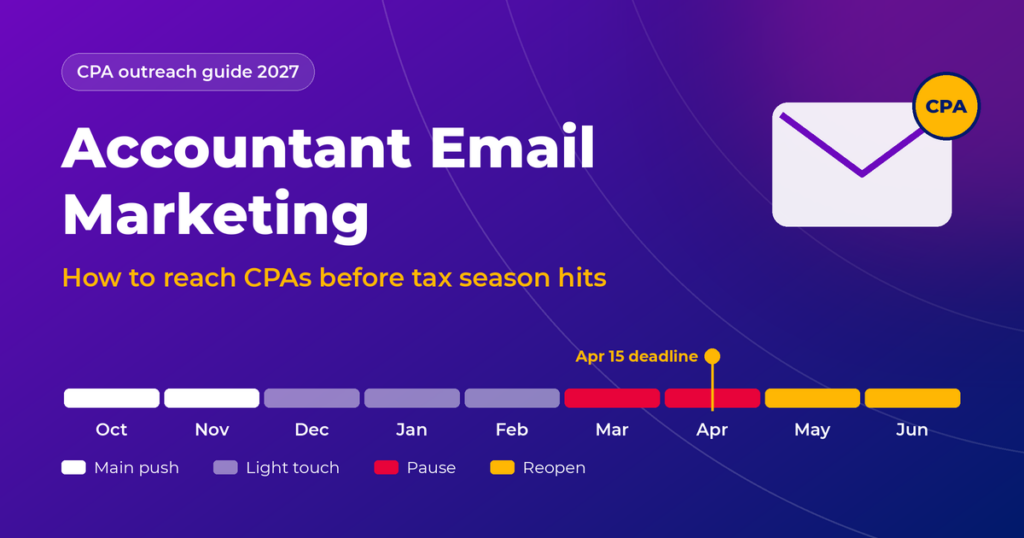
Accountant email marketing works best when it follows the tax calendar. Reach CPAs between October and early January, while firms are still planning and buying. Once returns start moving, inboxes go quiet until after April 15.
Every January, vendors who sell to accounting firms see the same thing. Their sequences go out just as CPAs open client organizers, and the replies never come. The offer was fine. The timing was not.
The IRS lists April 15, 2027 as the general deadline for 2026 individual returns. That date marks the end of the busy season, not the start. Your real window is the quiet stretch before it.
Key takeaways
- Prospect hardest from October to December. In January, offer short, practical help. From March to mid-April, pause broad cold outreach.
- Not every accountant is a CPA. Separate licensed CPAs, PTIN holders, enrolled agents and firm staff.
- Segment by firm size and service line. Then write one problem, one offer and one call to action per email.
- CAN-SPAM has no B2B exception. Authenticate your domain and honor opt-outs within 10 business days.
Why CPA Email Marketing Runs on the Tax Calendar
Tax season is a huge, fixed workload, and the people handling it are already stretched.
BLS also notes that overtime is typical for accountants during tax season. The AICPA found that 75% of responding firms that hired in 2024 expected the same or higher hiring in 2025.
Put together, firms need help but have little attention to spare once returns start moving. The question is not whether CPAs read email. It is when they have room to act on it.
When to Email CPAs: The 2027 Outreach Calendar
The best time to email CPAs is before the work arrives. The IRS has not announced the 2027 opening day yet. The 2026 season opened on January 26, so plan around a late January start.
This calendar is a planning model, not measured response data. Confirm mid-March business deadlines against the final 2027 IRS Publication 509 before you schedule sends.
Who You Are Actually Emailing: CPAs, Preparers and Everyone in Between
“Accountant” and “CPA” are not the same audience. Treating them as one is the fastest way to lose credibility with a reader trained to spot errors.
Also separate the firm from the person. A practice administrator may evaluate your tool, but a partner usually signs off.
How to Build a CPA Email List You Can Trust
A reliable CPA email list comes from combining sources and verifying each contact. Here are the main paths, from cleanest to fastest.
- First-party opt-in. Webinars, CPE resources, state CPA society events and useful checklists. It is slow to scale but best for long-term nurture.
- Firm website research. Confirm service lines, named leaders and published business contact details.
- State board license lookups. Check that a contact holds an active CPA license. License data confirms credentials; it is not a marketing list.
- IRS PTIN files. The IRS publishes PTIN data by state, updated twice a year. It helps with geographic discovery, but PTIN status does not prove a CPA credential or a usable email.
- B2B data providers. The fastest way to scale, but quality varies widely. A ready-made CPA email list or a broader accountants email list saves months of research. Buying data never transfers your compliance obligations, though.
Six questions to ask any list vendor
| Check | Ask the vendor | Red flag |
|---|---|---|
| Definition | Are these licensed CPAs, PTIN preparers, all accountants or firms? | Terms used interchangeably |
| Provenance | Where and how was each email obtained? | “100% opt-in” with no proof |
| Freshness | When were employer, role and mailbox last verified? | No timestamps |
| Targeting | Can you filter by role, firm size and specialty? | Only a generic “accountant” tag |
| Suppression | Can you remove our opt-outs before delivery? | No suppression support |
| Quality | Can we test a representative sample first? | “Zero bounce” guarantees |
Segment Accounting Firms Before You Write a Word
A solo tax preparer and a 12-office regional firm have almost nothing in common day to day. Segment by firm size and service line first, then match the offer. Treat the priorities below as hypotheses to test, not survey findings.
| Segment | Likely priority | Better-fit offer |
|---|---|---|
| Solo CPA or boutique tax practice | Less admin time, simple onboarding | Intake automation, secure upload |
| Small local firm (about 2 to 20 people) | Document collection, staff utilization | Client portal, practice management |
| Midsize regional firm | Cross-office workflow, capacity control | Workflow platforms, security, process consulting |
| Audit and assurance firm | Engagement workflow, document control | Audit documentation, secure collaboration |
| CAS or outsourced accounting firm | Recurring monthly work, advisory capacity | Automation, integrations, outsourced delivery |
For a closer look at the roles and titles inside these firms, see our guide to accounting professionals email lists.
How to Write Cold Emails CPAs Will Answer
CPAs are trained skeptics. They read for accuracy, spot vague claims and delete anything that sounds like a sales deck. Follow these rules:
- Keep it to 60 to 120 words. Treat that range as a starting point to test.
- Use one problem, one offer and one CTA. A 10-minute fit check beats a 30-minute demo.
- Make one verified observation. Mention something true about the firm, such as its service mix or location.
- Lead with an operational outcome. Less document chasing, secure client files or seasonal coverage. Skip “revolutionize tax season.”
- Never invent proof. No made-up client wins, time savings or partnerships, and no fake “Re:” subject lines.
Hi [First name],
I noticed [Firm] handles both individual returns and monthly bookkeeping for small businesses. If chasing missing client documents eats into your January, [Product] sends those reminders automatically through a secure upload link.
Worth a 10-minute fit check before the rush starts? If the timing is wrong, I’m happy to reconnect after April 15.
[Name], [Company], [Postal address] · Unsubscribe
An illustrative example to adapt and test, not a proven template.
Subject lines to A/B test
- Pre-season: “Before the January rush,” “Preparing [Firm] for 2027 intake?” and “Question for your tax operations team”
- Firm-specific: “For your small-business tax clients” and “Secure document intake at [Firm]”
- Postseason: “What to improve after April 15” and “Planning for next filing cycle?”
A Pre-Season Sequence With a Busy-Season Stop Rule
Run a light, four-touch sequence between October and December.
How to Measure CPA Campaigns Without Misleading Benchmarks
You will see benchmarks like Mailchimp’s Business and Finance figures: a 31.35% average open rate, 2.78% click rate and 0.15% unsubscribe rate. Those numbers describe permission-based newsletters across a broad category, not cold email to CPAs. Don’t set targets against them.
Don’t rely on
- Open rates, which privacy features in mail apps distort
- Category benchmarks from opt-in newsletters
Track instead
- Hard bounce rate, split by list source
- Reply rate: positive, neutral and negative
- Qualified replies that match your ideal customer profile
- Meetings booked and show rate
- Spam complaint rate
- Qualified pipeline per 1,000 emails delivered
CAN-SPAM and Deliverability Rules for Accountant Email Marketing
The FTC is explicit: CAN-SPAM has no business-to-business exception. Every commercial email to a CPA must:
- Use accurate header information and a truthful subject line
- Identify the sender clearly and include a valid physical postal address
- Offer a clear opt-out and honor it within 10 business days
CAN-SPAM is an opt-out law, but that does not make every purchased list lawful. State privacy laws and your vendor contracts can still apply.
Inbox providers add their own rules. Google’s sender guidelines for personal Gmail accounts require SPF or DKIM, valid reverse DNS, TLS and a spam rate under 0.3%. Senders of more than 5,000 messages a day to Gmail also need SPF and DKIM, DMARC alignment and one-click unsubscribe.
Your baseline checklist:
- Authenticate your domain and set up DMARC
- Send from a domain your recipients can identify
- Validate addresses before every campaign
- Keep one company-wide suppression list
- Monitor spam complaints weekly
Frequently Asked Questions
When is the best time to email CPAs?
October through early January is the strongest window, with a second opening after April 15. Test your own timing, since no published data confirms a best day or hour for CPAs.
Is it legal to buy a CPA email list?
In the US, CAN-SPAM regulates how you send, not whether you may buy data. You still need lawful sourcing, accurate headers, a postal address and working opt-outs. State laws may add requirements.
Are PTIN holders the same as CPAs?
No. Anyone paid to prepare federal returns needs a PTIN. CPA status is a separate state license that you must verify on its own.
Reach CPAs Before the Rush, Not During It
Accountant email marketing rewards teams that respect the calendar. Build a verified list, segment by firm type and write short emails with one clear outcome. Do the heavy lifting before January, step back during the deadline crunch and return in late April with something useful.
The firms that hear from you at the right moment are the ones that remember you next season.
Start your pre-season campaign with verified CPA contacts
LakeB2B builds CPA and accounting firm lists around the segments in this guide, so your October outreach starts with the right people.
Explore the CPA email list