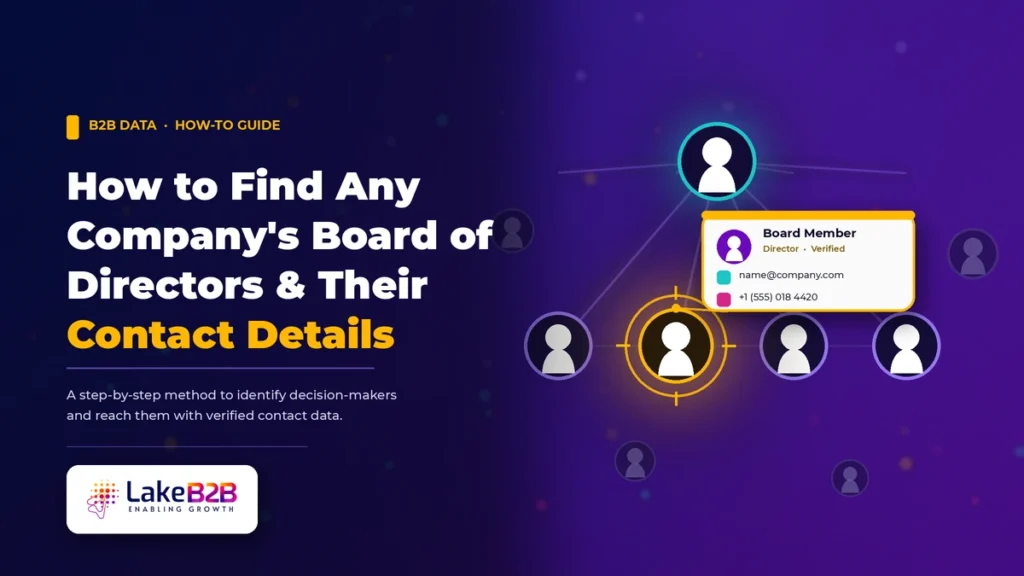
How to Find Any Company’s Board of Directors & Their Contact Details
Summarize with AI
|
Getting your Trinity Audio player ready...
|
Most people who search for a company’s board of directors are actually asking two different questions at once. The first is “who sits on the board?” The second is “how do I reach one of them?” These feel like the same task. They are not.
Identifying board members is usually straightforward, because public companies are required to disclose them. Reaching a specific director is a different problem, because individual director emails and phone numbers are rarely published anywhere. Treat these as one job and you will waste hours chasing a personal email that does not exist. Treat them as two, and you will move faster and land in the right inbox.
Start with the company’s own official records to identify directors, verify that the board is current against a recent filing, and reach the board through its published channel (a “Contact the Board” page or the Corporate Secretary) instead of hunting for a director’s personal email. Identification and contact are two separate research tasks, and confusing them is the single biggest reason board research fails.
The Two Jobs Hiding Inside One Question
The fastest way to improve your board research is to split the request in two before you open a single tab. Finding who is on a board and finding how to contact a director are separate tasks with separate sources and separate success rates.
Board membership is a matter of public record for listed companies. Regulators, stock exchanges, and the companies themselves publish it, and they are legally motivated to keep it accurate. That is why you can usually confirm a full board in minutes.
Contact information sits on the other side of a wall. A company will happily tell the world that Jane Doe chairs its audit committee. It will almost never publish Jane Doe’s direct email. Instead, most companies route all board communication through an official channel, often the Corporate Secretary or an investor relations address. Once you accept that, the “how do I contact them?” problem changes shape entirely. You are not looking for a hidden personal inbox. You are looking for the published door the company built for exactly this purpose.
Keep this principle in view for the rest of the guide: director identification is not the same as director contact enrichment. One is nearly always possible. The other depends on the company, the jurisdiction, and what is legitimately public.
What a Company’s Board of Directors Actually Is
A board of directors is the group that governs a company on behalf of its shareholders, and it is not the same thing as the executive team that runs it day to day. The people who manage the business and the people who oversee it can overlap, but they are not automatically the same list.
A typical board mixes a few roles. There is usually a chairperson, a set of independent (or non-executive) directors who bring outside oversight, and sometimes executive directors such as the CEO who sit on the board as well. Directors are often organized into committees, most commonly audit, compensation, and nominating or governance committees.
This distinction matters for research accuracy. If you copy a company’s “Leadership” or “Management Team” page and call it the board, you will frequently be wrong. Some executives are directors. Many are not. And some directors hold no operating role at the company at all. Confirm the board as the board, not as a proxy for the leadership page.
The Source-First Board Method
Here is the repeatable framework this guide is built around. Call it the Source-First Board Method, and run it in three stages every time: Identify, Verify, Reach.
The logic is simple. You start as close to the company’s official record as possible (Identify), you confirm the record is still current because boards change (Verify), and only then do you work out the correct way to make contact (Reach). Skipping straight to a search engine or a third-party profile is what produces stale names and dead email addresses.
- Stage 1, Identify. Pull the current board from official and regulatory sources, starting with the company itself.
- Stage 2, Verify. Confirm each director is current by cross-checking a recent filing or announcement. Boards are not static.
- Stage 3, Reach. Use the company’s published board contact channel first. Pursue individual professional contact details only where they are legitimately public.
The rest of the guide is these three stages in detail, followed by the tools, edge cases, and mistakes that decide whether your research holds up.
Stage 1, Identify: Where Current Directors Are Actually Published
For a public company, you should almost never have to guess who is on the board, because at least four independent sources will tell you. The Library of Congress company research guidance points researchers to a company’s own About Us and Investor Relations pages first, then to regulatory proxy filings, with professional profiles and broader web research used to fill gaps. That order is a good default. Work down this list until you have a confident, current list of names.
1. The Company’s Governance or Leadership Page
Start on the company’s own website, because it is the closest thing to the official current record. Look under navigation paths such as About Us, then Leadership; About, then Board of Directors; Company, then Governance; or Investor Relations, then Corporate Governance.
A good board profile page will usually give you each director’s full name, their title (chair, director, lead independent director), their independent or non-independent status, committee memberships, a short biography, prior roles, education, other board seats, and often an appointment date. Treat the company’s governance page as your first verification source, not just your first search result.
2. The Investor Relations Section
For listed companies, the Investor Relations (IR) section is where governance information is consolidated. It typically holds Corporate Governance, Board of Directors, and Management pages alongside SEC filings, annual reports, proxy statements, and shareholder information.
IR sections are useful because they gather the governance documents in one place, and they usually link the board page to the filings that back it up. A clean research path through most IR sites looks like this: Company website, then Investor Relations, then Corporate Governance, then Board of Directors, then the governance documents and contact page.
3. The Annual Report
Annual reports consolidate board and governance information into a single document, which makes them one of the highest-value sources you can pull. Depending on the company, an annual report can list board members, the chair, executive and non-executive directors, independent directors, committee memberships, director biographies, the company secretary, the registered office, and an IR contact.
For companies outside the United States, the annual report is often more useful than trying to force everything through U.S. filings. To find one quickly, search for the company name with “annual report” and the year, or search the company’s own domain for a PDF.
4. SEC EDGAR and Proxy Statements (U.S. Public Companies)
For U.S. public companies, from the Fortune 500 down to smaller listed firms, SEC EDGAR is one of the most valuable sources available, and the proxy statement is the single richest document in it. The DEF 14A proxy statement is where a U.S. company lays out its directors, its nominees, their qualifications, committee assignments, board structure, independence, and director compensation in detail.
A modern proxy statement, such as Microsoft’s 2025 filing, contains dedicated sections on director selection and qualifications, board composition and diversity, the director nominees themselves, director compensation, and corporate governance. That is far more depth than a website bio.
The annual Form 10-K is the second document to know. It can carry an Executive Officers and Directors section that identifies board members and executive officers together, as seen in a recent Super Micro Computer (Supermicro) 10-K. When a company’s proxy is dense, the 10-K can be a faster confirmation.
To search EDGAR efficiently, work in order: identify the company’s legal name, then its ticker and CIK where they exist, then open its EDGAR filings, then look for the latest DEF 14A, 10-K, 8-K, and governance filings. Inside those documents, search for terms like “Board of Directors,” “Director,” “Nominee,” “Corporate Governance,” “Contact the Board,” “Corporate Secretary,” and “Executive Officers.”
5. Stock Exchange Filings (Non-U.S. Companies)
SEC EDGAR is not a universal source for every company on earth, and assuming it is will cost you outside the United States. For companies listed elsewhere, the relevant stock exchange is often the equivalent source. Depending on the market, that could be the LSE, SGX, ASX, HKEX, TSX, NSE or BSE, Euronext, Nasdaq, or the NYSE.
Disclosure requirements differ by jurisdiction, so the exact document and its contents will vary. The point is to adapt your method to the company’s country, exchange, legal structure, and public or private status rather than defaulting to a single source.
6. Government and Company Registries
Official corporate registries are a separate layer, and in some jurisdictions they are the most authoritative source of all for director names. Examples include Companies House in the United Kingdom, ASIC in Australia, and ACRA in Singapore, along with other national and state registries.
Depending on the jurisdiction and company type, a registry may provide director names, appointment and resignation dates, company status, registered office, company number, and filing history. Note the limit, though: a registry will often tell you who the directors are without giving you a single business email or phone number. That is identification, not contact enrichment, and it is exactly why the two stages stay separate.
7. LinkedIn and Business Databases (Enrichment, Not Authority)
LinkedIn and commercial business databases have a place, but it is a supporting one. Use LinkedIn primarily to confirm a person’s identity and professional history, not to establish who currently sits on a board. A profile can be out of date, and a board seat may not appear on it at all.
Commercial databases, including curated options like a C-level executives contact database, can be useful for enrichment fields such as job title, professional history, corporate email, business phone, and location. Cross-check whatever they return against official sources when accuracy matters, because these records can go stale. A sound reliability hierarchy runs: official company source, then government or regulatory source, then a reputable database, then a professional profile, then a general web result.
Stage 2, Verify: Confirming the Board Is Current
A board is a moving target, so a name you found is only as good as the date attached to it. Directors are appointed, they resign, they retire, they are elected or re-elected at annual meetings, boards expand, and committee assignments shift. An accurate-looking list from an old proxy statement can be wrong today.
The most common verification failure is trusting a single, undated source. The fix is a simple triangulation: the latest company governance page, plus the latest applicable filing, plus any recent company announcements. When those three agree, you can be confident. When they disagree, the most recent official source wins.
Company press releases are the fastest early-warning system for board changes, because appointments and departures are often announced there before they propagate everywhere else. Search the company name with terms like “appointed” and “board,” “joins the board,” “resigns,” “retires,” or “new director.” Then do the important part: treat the announcement as a lead, and confirm the current status against the latest governance page or filing before you rely on it.
Full name, current title, board status (executive, non-executive, independent), appointment date, committee, a short biography, the source URL, and the date you pulled it. Auditable notes are what let you defend the research later.
Stage 3, Reach: How to Actually Contact the Board
This is where most guides go quiet, and where the honest answer helps you most. A company will usually not publish an individual director’s email or phone number, but it will very often publish an official way to reach the board. Once you look for that channel instead of a personal inbox, the success rate climbs sharply.
Separate the two categories in your head:
| Board contact channels (usually published) | Individual director details (rarely published) |
|---|---|
| Board email address | Director’s direct business email |
| Corporate Secretary email or mailing address | Professional phone number |
| Governance contact form | Personal contact information |
| Investor relations contact |
The first category is the one you can actually rely on. Here is how to work it.
Search for a “Contact the Board” Page
Many companies build a dedicated page for shareholder and stakeholder communication with the board, and it is often buried below the obvious navigation. Microsoft, for example, publishes a “Contact the Board of Directors” page that provides an official communication channel and Corporate Secretary mailing information for board-related communications. A legitimate way to reach a board almost never requires a director’s personal email.
Find the Corporate Secretary
The Corporate Secretary is the governance role responsible for board communications, and reaching that office is frequently the correct and expected route. Hewlett Packard Enterprise, for instance, provides a Corporate Secretary address and email as the mechanism for communicating with board members. TD SYNNEX publishes Corporate Secretary information for board communications and, separately, an investor relations contact. Routing your message through the Corporate Secretary is not a workaround. It is the front door. In many organizations the Corporate Secretary works alongside the general counsel or chief legal officer, so a governance inquiry often passes through the legal function.
Check Investor Relations
When there is no obvious “Contact the Board” page, investor relations is the next stop. IR teams handle shareholder and stakeholder communication and can often direct a legitimate inquiry to the right governance contact. This is also the natural channel for questions tied to earnings, filings, or shareholder matters.
Look Inside the Filings
Board communication information sometimes lives inside regulatory filings rather than on the website. A Supermicro SEC filing, for example, includes board communication information with a board contact mechanism. If the website is thin, search the company’s latest proxy or annual report for “Contact the Board,” “Corporate Secretary,” or “communications with the board.”
A Note on Individual Contact Details
Where you do need an individual director’s professional contact information, pursue it only through legitimate, publicly available sources: the company itself, public professional profiles, reputable business databases such as verified U.S. business executive contact lists, and public professional contact pages. Respect the legal and ethical limits that apply in your jurisdiction and the person’s. And remember the distinction one more time: a published board or Corporate Secretary address routes to governance personnel, so never treat a board email as if it were a director’s personal address.
Google Search Operators That Cut Research Time
Search operators are the fastest way to surface governance pages and filings that a site’s own navigation hides. Swap in the real company name and use these as a starting toolkit.
To find the board itself:
"[Company Name]" "board of directors"
"[Company Name]" "board members"
"[Company Name]" corporate governance
To find governance PDFs and reports:
"[Company Name]" filetype:pdf "annual report"
"[Company Name]" filetype:pdf "proxy statement"
site:company.com filetype:pdf "board of directors"
To find the board’s contact channel:
"[Company Name]" "contact the board"
"[Company Name]" "corporate secretary"
site:company.com "communications with the board"
site:company.com "shareholder communications" "board"
To go straight to U.S. filings:
site:sec.gov "[Company Name]" "DEF 14A"
site:sec.gov "[Company Name]" "10-K"
site:sec.gov "[Company Name]" "director"
The “contact the board” and “corporate secretary” searches are the underused ones. They frequently reveal a dedicated governance or board-contact page that is impossible to find from the main menu.
Finding Directors of Private Companies
The method holds, but the sources thin out, because private companies carry far lighter disclosure obligations than listed ones. This is where the honest framing of “any company” matters: you can research any company, but not every company will have publicly available contact information for every director.
For a private company, the sources worth checking are the company website, the relevant corporate registry, state or national filings, press releases, professional profiles, industry databases, and news coverage. Registries are often the most reliable for confirming director names, even when they reveal nothing about how to reach those people. Expect to lean harder on verification and cross-checking here, and expect the contact stage to end at an official company channel more often than at an individual.
Finding Directors Internationally
The single biggest international mistake is assuming U.S. sources apply everywhere. SEC EDGAR is excellent for U.S. public companies and irrelevant for a private firm in Singapore. Match your source to the company’s jurisdiction, not to your habits.
A practical way to adapt: identify the country, the exchange (if listed), and the company’s legal structure first, then choose the matching source.
| Jurisdiction | Primary source to check first |
|---|---|
| United States | SEC EDGAR proxy (DEF 14A) and 10-K filings |
| United Kingdom | Companies House registry |
| Australia | ASIC registry |
| Singapore | ACRA registry, plus SGX for listed-company governance |
| Other markets | National registry plus the relevant exchange |
The three-stage method does not change across borders. Only the specific sources inside Stage 1 do.
Common Mistakes to Avoid
Even careful researchers trip on the same handful of errors. Watch for these.
- Relying only on LinkedIn. It helps confirm identity, but it is not an authoritative record of current board membership.
- Trusting an outdated annual report. Board composition can change after publication. Always check the date.
- Assuming the CEO is automatically a director. Some CEOs sit on the board. Some do not. Verify it, do not assume it.
- Confusing executives with directors. The leadership team and the board are not the same list, even when they overlap.
- Treating a board email as a director’s personal email. A published board or Corporate Secretary address routes communications to governance staff.
- Depending on a single database. Commercial records can be stale or wrong. Cross-check anything that matters.
- Ignoring jurisdiction. EDGAR is not universal. Companies elsewhere require exchange filings or national registries.
The Board Research Checklist
Run this end to end and your board research will hold up to scrutiny.
- Identify the company. Collect the legal name, brand name, website, country, ticker, exchange, and CIK where applicable.
- Find the board. Check, in order: company website, investor relations, corporate governance, annual report, proxy statement, regulatory filings, and the government registry.
- Verify every director. Capture full name, current title, board status, appointment date, committee, biography, source URL, and source date.
- Find official contact channels. Look for a “Contact the Board” page, the Corporate Secretary, board communications information, investor relations, and any governance contact page.
- Research individual contact details where appropriate. Only through legitimate, publicly available sources, and within legal and ethical limits.
- Cross-check. Confirm anything important against at least two independent sources before you rely on it.
Company name, legal name, website, country, exchange, ticker, CIK, director name, board position, director type, appointment date, committee, biography, LinkedIn URL, official board contact, Corporate Secretary, IR contact, business email and phone (only where legitimately public), source URL, source date, and last verified date.
Frequently Asked Questions
How do I find the board of directors of a company?
Start with the company’s own governance or investor relations page, then confirm it against a recent filing such as a proxy statement or annual report, or the relevant national registry. For U.S. public companies, the DEF 14A proxy statement on SEC EDGAR is the richest single source.
Can I find a director’s personal email address?
Usually not. Individual director emails are rarely published. Most companies route board communication through an official channel, typically the Corporate Secretary or an investor relations contact, which is the legitimate and expected way to reach a director.
How do I contact a company’s board of directors?
Look for a “Contact the Board” page on the company website, or reach the Corporate Secretary, whose office is responsible for board communications. If neither is obvious, investor relations can usually direct a legitimate inquiry to the right governance contact.
What is a Corporate Secretary?
The Corporate Secretary is the governance role responsible for board administration and communications. A published Corporate Secretary address or email is often the official route for correspondence intended for the board.
What is an SEC DEF 14A?
The DEF 14A is a proxy statement filed by U.S. public companies. It sets out directors and nominees, their qualifications and biographies, committee assignments, board structure, independence, and director compensation, making it one of the most detailed board research documents available.
How do I find directors of a private company?
Check the company website, the relevant corporate registry, state or national filings, press releases, professional profiles, and news coverage. Registries are often the most reliable for confirming names, though private companies disclose far less than listed ones.
How do I verify whether someone is currently a director?
Triangulate the latest company governance page, the latest applicable filing, and any recent company announcements. When sources disagree, trust the most recent official one.
How do I find company directors in the UK, Australia, or Singapore?
Use the national registry: Companies House in the UK, ASIC in Australia, and ACRA in Singapore. For listed companies, the relevant exchange, such as SGX, also publishes governance material.
How can I find recently appointed board members?
Company press releases are the fastest source for new appointments and departures. Use the announcement to spot the change, then verify the current status against the governance page or a filing.
Related Resources
Once you have identified the right decision-makers, these curated contact lists can help you reach verified executives faster:
Put the Method to Work
Identification is nearly always possible through official sources. Contact is about finding the door the company already built, not a door it hid. Turn the checklist above into a research sheet, add a “last verified” date to every row, and run Identify, Verify, Reach the same way every time.
Table of Contents
Ready to turn insights into pipeline?
LakeB2B helps you find, enrich, and connect with verified B2B contacts using accurate data, intent signals, and audience intelligence so your sales and marketing teams can reach the right decision-makers with confidence.