Attorney Email Marketing in 2026: How to Reach Lawyers by Practice Area
Summarize with AI
|
Getting your Trinity Audio player ready...
|
A personal injury intake director and a Chapter 11 restructuring partner are both attorneys. Send them the same email, and you will likely get the same response from each: nothing.
That is the core problem with most attorney email marketing. Lawyers read email all day, but they ignore messages written for “lawyers” in general. They answer messages written for their practice, their role and the problem on their desk this week.
This guide is for companies that sell to law firms: legal tech vendors, intake and answering services, data providers, agencies and document services. It is not about law firms emailing prospective clients, which is a separate discipline with its own ethics rules.
Build attorney campaigns practice area first. Segment by practice, firm type and buying role, document why each contact belongs there, then write one relevant message per segment. Measure qualified replies, not sends.
Why One-Size Lawyer Lists Stop Working
A license tells you someone practices law. It does not tell you what they need.
A plaintiff PI firm lives on intake speed. A consumer bankruptcy practice spends its week chasing client paperwork before filing deadlines. A large-firm corporate group buys through partners, IT and procurement. One pitch cannot fit all three.
Firm size changes the buyer, too. At a solo practice, the owner uses, approves and pays. At a 200-lawyer firm, the intake manager feels the pain, while a COO or legal operations director holds the budget.
The ABA’s 2023 Profile of the Legal Profession, as compiled by MyCase, found that about 40% of law firms use email marketing and 87% have a website.
That figure shows how firms market themselves, not how lawyers respond to vendors. Its real lesson is that attorney inboxes are already crowded with clients, courts and opposing counsel. That is your competition.
The Practice, Role, Proof Framework
Before a contact enters a campaign, it should pass three checks: the right practice, the right role, and proof of both.
- Practice: Go one level below the headline area. “Bankruptcy” is a category. “Consumer Chapter 7 and Chapter 13 debtor counsel” is a segment.
- Role: Identify who feels the problem and who signs. At small firms, that is one person. At large firms, it rarely is.
- Proof: Know where each practice tag came from, when it was last checked, and how the address was obtained.
Use the fields below to run each check.
| Field | Example values |
|---|---|
| Practice and subpractice | PI plaintiff, family mediation, Chapter 11, DUI defense, M&A |
| Role | Partner, managing partner, intake lead, legal ops |
| Firm type | Solo, small, mid-size, large, in-house |
| Evidence of fit | Practice page, attorney bio, state bar record, opt-in preference |
| Source and status | Collection date, permitted use, last verified, suppression flag |
Any record missing practice, role or proof goes back to research, not into the send.
How to Reach Lawyers by Practice Area
Each practice area has its own workflow, vocabulary and buyer. Write to that, not to “law firms.”
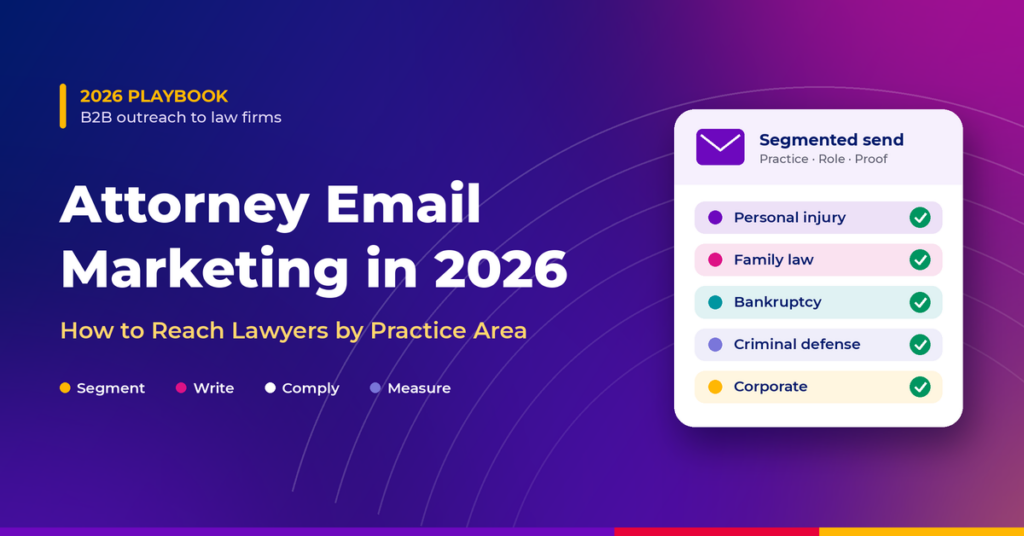
| Practice area | Split first by | Who to email | Lead with |
|---|---|---|---|
| Personal injury | Plaintiff vs defense | Owner, or managing partner plus intake lead | Intake speed and lead routing |
| Divorce and family | Divorce-only vs broader family law | Owner at solo and small firms | Confidential intake and scheduling |
| Bankruptcy | Consumer vs business, debtor vs creditor | Owner or practice lead | Document collection and deadlines |
| Criminal defense | Private defense vs prosecutors | Owner or operations lead | After-hours intake and secure contact |
| Corporate | Law firm vs in-house counsel | Practice leader, general counsel or legal ops | Contract workflow and legal spend |
Personal injury attorneys
PI firms buy around intake. Every missed weekend inquiry is a case that may sign elsewhere. After the plaintiff and defense split, segment by case type (auto, premises, medical malpractice, mass tort), office count and state. Promise operational gains such as faster lead routing, never a number of signed cases. A practice-tagged personal injury attorney email list makes that first split much easier.
Subject lines to test: PI intake workflow Intake routing at [Firm]
Divorce and family law attorneys
Most “divorce attorney email marketing” content covers lawyers emailing clients. Here, you are the vendor emailing the lawyer. Separate mediation and collaborative practices from litigation-heavy boutiques. Keep the tone calm and discreet, and never mention clients or family disputes. When you source a divorce attorney email list, check that “family law” tags have not been applied too broadly.
Subject lines to test: Family-law intake question Scheduling at [Firm]
Bankruptcy attorneys
Bankruptcy is deadline and document work. Separate Chapter 7 and Chapter 13 consumer practices from Chapter 11 restructuring teams, and keep trustees in their own segment. High-volume consumer firms run like operations businesses. Pitch document collection, deadline tracking and client status updates. Never imply you know about rising filings or specific debtors.
Subject lines to test: Chapter 13 document collection Fewer document follow-ups
Criminal defense attorneys
Defense work runs on urgency, often after hours. Many “criminal lawyer” lists mix private defense attorneys with prosecutors and public defenders. Those government lawyers buy through procurement, so remove them. Then split state from federal work, and DUI from white-collar or appeals. Avoid fear-based copy, and never mention any individual’s case.
Subject lines to test: After-hours intake Secure inquiry routing
Corporate lawyers and in-house counsel
Outside counsel at a firm and in-house counsel at a company are two different buyers. Segment each by practice (M&A, contracts, employment, privacy), industry and team size. Expect a committee: a general counsel or legal ops lead may own the budget, while IT reviews security. Your first email should open a conversation, not close a deal.
Subject lines to test: Contract review at [Company] Legal ops question
How to Write Emails Lawyers Actually Answer
Short, specific and verifiable beats polished and long.
In a 2025 cross-industry analysis of about 5.5 million B2B emails, Belkins found that personalized subject lines earned 46% opens versus 35%, and 7% replies versus 3%.
Treat this as a direction to test, not a benchmark for lawyers. Privacy features also distort open rates, so judge results by replies. Then use a five-part structure:
- A real sender name and company.
- One verified reason this lawyer is relevant.
- One workflow problem and a believable fix.
- A small question instead of a meeting request.
- Your postal address and a clear unsubscribe link.
Hi Daniel, your site says Morgan & Reyes handles auto and premises cases across three Ohio offices, with 24/7 consultations. Multi-office PI firms often tell us that weekend web inquiries sit in a shared inbox until Monday. We route each new inquiry to a named intake owner within minutes.
Is after-hours routing solved for your team, or is it still a work in progress?
Priya Nair, [Company] · [Address] · [Unsubscribe]
The names above are illustrative. Skip invented referrals, fake familiarity and results you cannot prove. Test one subject line variable at a time.
Compliance: CAN-SPAM, GDPR and PECR
Lawyers notice compliance mistakes faster than anyone. This is a summary, not legal advice.
United States. The FTC is clear that CAN-SPAM covers B2B email. Use accurate headers and honest subject lines, identify ads where required, include a postal address, and honor opt-outs within 10 business days. Hiring a vendor or agency does not shift your responsibility. CAN-SPAM does not generally require opt-in, but that is not blanket permission to use any list.
European Union. The European Commission expects buyers of third-party data to verify provenance and lawful use. Legitimate interest needs a documented balancing test. Contacts must generally be told where you got their data by your first message, and national ePrivacy laws may require consent.
United Kingdom. The ICO treats corporate subscribers differently from sole traders and some partnerships, who may need to give consent. Personal data about named solicitors is still covered by UK GDPR.
Ethics rules. ABA Model Rule 7.3 governs lawyers soliciting clients, not vendors emailing lawyers.
Inbox rules. Gmail’s sender guidelines require SPF, DKIM and DMARC authentication, low spam complaint rates and easy unsubscribe. Your email platform may also ban purchased lists outright.
Should You Build or Buy an Attorney Email List?
Either works if you can prove where every record came from. A built list grows slowly but carries real context. A licensed list adds coverage quickly, provided the vendor holds up. Before you buy, ask:
- Where and when was each address collected?
- Is it a personal work email, a role inbox or a guessed pattern?
- How is practice area assigned, and when was it last checked?
- What does “verified” mean, technically and in the contract?
- What marketing use is permitted in each target country?
- How are opt-outs and complaints removed?
- Can we test a sample by state and practice first?
If you license, start with a practice-segmented attorney email list and run these questions against a sample. To build your own, offer practice-specific opt-in resources, sponsor events with clear attendee permissions, and use state bar directories to confirm licensing, never as marketing consent.
Measure Qualified Conversations, Not Sends
The real answer to how to get leads from attorneys is fewer, better-fit sends. Start with one subpractice, one firm size and two states. Send a small test from an authenticated domain, then expand, adjust or stop.
Track qualified conversations per 1,000 eligible contacts, positive reply rate, meetings and pipeline by segment, bounce rate, and opt-out and complaint rates. Set targets from your own early results, not cross-industry benchmarks.
This is slower than blasting a broad list. Practice tags drift, and large-firm deals take months. The trade-off is fewer complaints and conversations that actually go somewhere.
From Lawyer Lists to Practice-Level Intelligence
Winning attorney outreach in 2026 depends less on reach and more on precision: the right subpractice, the right role and a source you can defend. The same is true for AI-drafted outreach. A model can write a sharp PI email in seconds, but if the contact is a defense lawyer who changed firms last year, that email is wasted.
Before your next campaign, request a sample segmented by practice area, jurisdiction and firm size, then check its source, collection date and permitted use.
Request a segmented sampleFAQs
Is buying an attorney email list legal?
It depends on location and use. In the US, CAN-SPAM rarely requires opt-in for B2B email, but its sending rules still apply. In the EU and UK, GDPR, ePrivacy and PECR may require a lawful basis, notice or consent.
What is the difference between an attorney mailing list and an email list?
A mailing list often means postal addresses for direct mail. An email list contains email addresses. Confirm which one you are buying.
Which subject lines work best for lawyers?
Short, practice-specific subject lines, such as “Chapter 13 document collection,” are a strong starting point. Judge them by replies rather than opens.
Table of Contents
Ready to turn insights into pipeline?
LakeB2B helps you find, enrich, and connect with verified B2B contacts using accurate data, intent signals, and audience intelligence so your sales and marketing teams can reach the right decision-makers with confidence.